


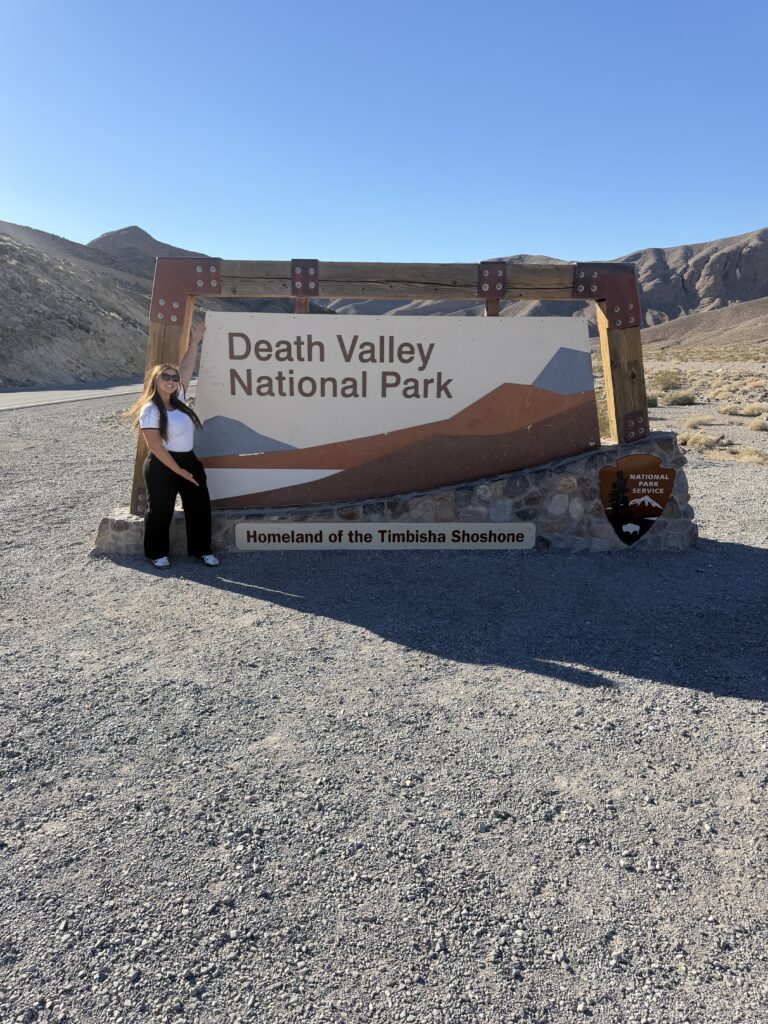
We spent 3 days in Death Valley based right in the middle of the park at The Ranch at Death Valley, and staying inside the park made all the difference in the hottest, driest and lowest national park in the country. Saira and I caught sunrise at Zabriskie Point, walked out onto the salt flats at Badwater Basin, rode horses into the desert at sunset and went to a star party under some of the darkest skies in the U.S. We partnered with The Oasis at Death Valley for this stay, and here’s our full itinerary, where to stay, where to eat and everything we’d tell a friend before they go.
This post contains affiliate links. If you book or buy through them, we may earn a small commission at no extra cost to you. Thanks for supporting Travel Squad Podcast!
Want to see it all without the planning? Our Death Valley itinerary has every stop, drive time and Squad Tip from this trip.
Plan Your Death Valley Trip: Quick Links
- Day-by-day plan: our Death Valley National Park Itinerary
- Where we stayed: The Ranch at Death Valley (luxury option: The Inn at Death Valley)
- Tours and activities: our Death Valley tours on Viator
- Flights: Thrifty Traveler Premium (code TSP = $20 off your first year)
- What to pack: layers, a hydration pack and trail shoes from our Hiking Must-Haves list
Death Valley Trip at a Glance
- How many days: 3 days, 2 nights (November 6–8, 2026). We drove in Friday afternoon and explored The Ranch, spent Saturday seeing the big sights, and hiked Mosaic Canyon on Sunday before the drive home.
- Best time to visit: October through May. Summer temperatures often go over 120°F, and the Furnace Creek Stables only run October through mid-May.
- Where we stayed: A Cottage at The Ranch at Death Valley, part of The Oasis at Death Valley in Furnace Creek. For the luxury option, book The Inn at Death Valley next door.
- Getting there: We drove about 7 hours. Flying? Las Vegas (LAS) is the closest major airport, about 2 to 2.5 hours from Furnace Creek.
- Getting around: You need a car. There’s no public transportation to or around the park, and the stops are spread out.
- Budget: Most of the best stops are free once you’re in the park: viewpoints, short walks, the salt flats and the Borax Museum. Your big costs are the park entrance fee, your hotel and gas, so fill up before you go.
- Great for: sunrise and sunset photos, stargazing, easy hikes, first-time national park visitors and a warm winter getaway.
Why Visit Death Valley
View this reel on Instagram: our Death Valley trip highlights
Watch our Death Valley highlights, and follow @travelsquadpodcast for more.
Death Valley is the hottest, driest and lowest national park in the country, and it’s also the largest national park in the lower 48 at about 3.4 million acres. It gets only about 2 inches of rain a year and holds the record for the hottest temperature ever recorded on Earth. It became a national monument in 1933 and a national park in 1994, and in 2013 it was named a Gold Tier International Dark Sky Park, the highest rating there is.
So much of what you see here ties back to borax. In the late 1800s, borax was mined in the valley and hauled out by twenty-mule teams (yes, that’s where 20 Mule Team Borax comes from). The Pacific Coast Borax Company later went into tourism, built The Inn in 1927 and pushed for Death Valley to become a park, which is why places like Zabriskie Point, Twenty Mule Team Canyon and Harmony Borax Works all have borax names. And for the Star Wars fans: scenes from the original movie were filmed at the Mesquite Flat Sand Dunes, Artists Drive and Dante’s View.
We first covered Death Valley back in episode 23 in 2019. That was a quick Saturday-Sunday trip with one night at a hotel outside the park, and we spent most of the weekend in the car. Staying inside the park this time changed everything.
Day 1: Arrive and Explore The Ranch at Death Valley
We left at 8 am, drove about 7 hours and rolled into Furnace Creek around 3 pm. Check-in at The Ranch at Death Valley is at 4 pm, so we had just enough time to wander the property before settling into our Cottage.
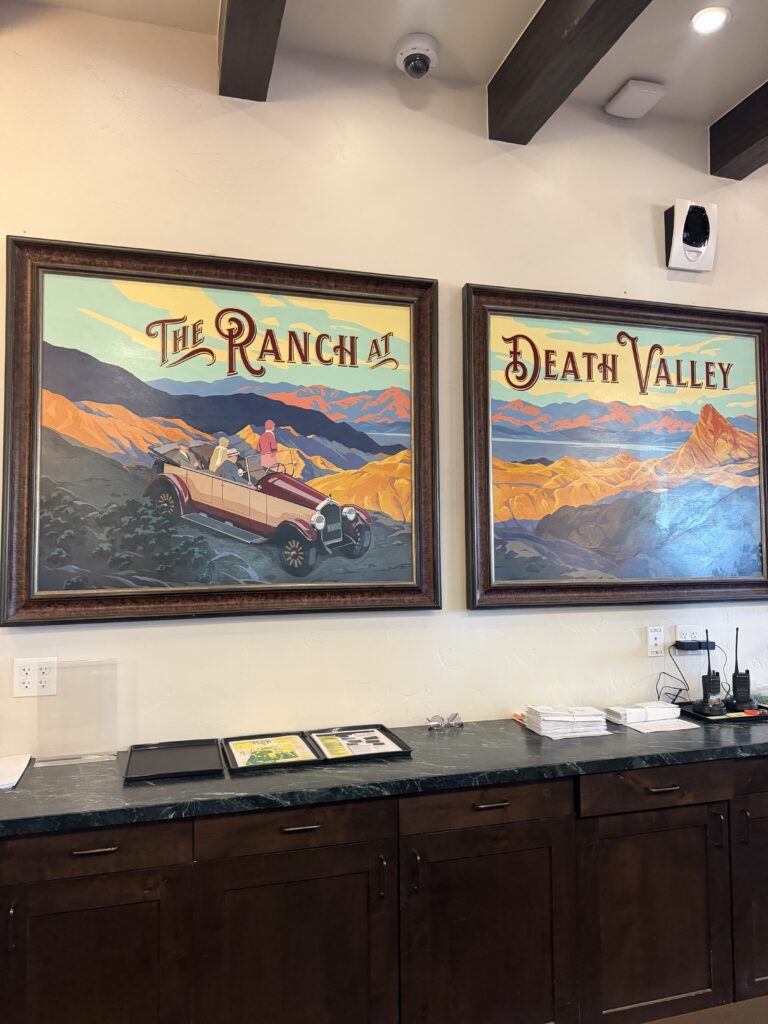
Where We Stayed: The Ranch at Death Valley
Our number one tip is to stay inside the park. Everything in Death Valley is spread out, and staying at The Oasis at Death Valley in Furnace Creek cut our driving way down. The Oasis sits on private land inside the park, right next to the National Park Service visitor center, and has two hotels.
The Ranch at Death Valley is the casual, adventure-focused, family-friendly side of The Oasis. Before it was a hotel, this was Greenland Ranch, built in the 1880s to support the borax workers and their twenty-mule teams after borax was found nearby in 1881. It later became Furnace Creek Ranch and the crew headquarters for the Pacific Coast Borax Company, and it first opened to guests in 1933. It sits about 178 feet below sea level.
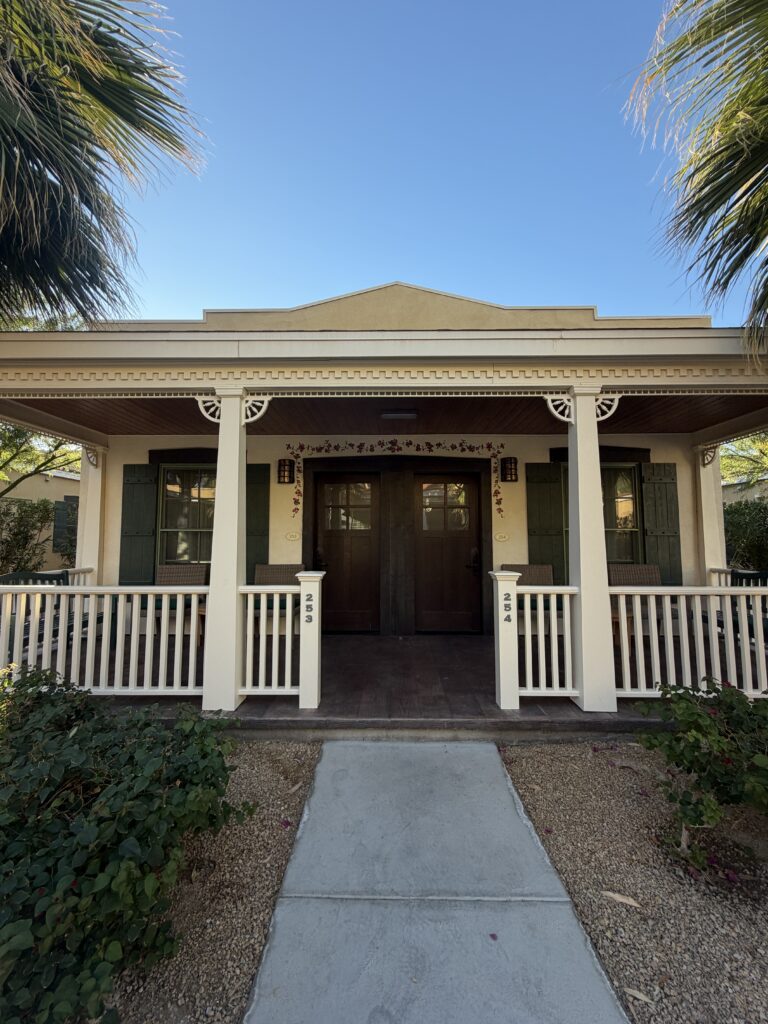
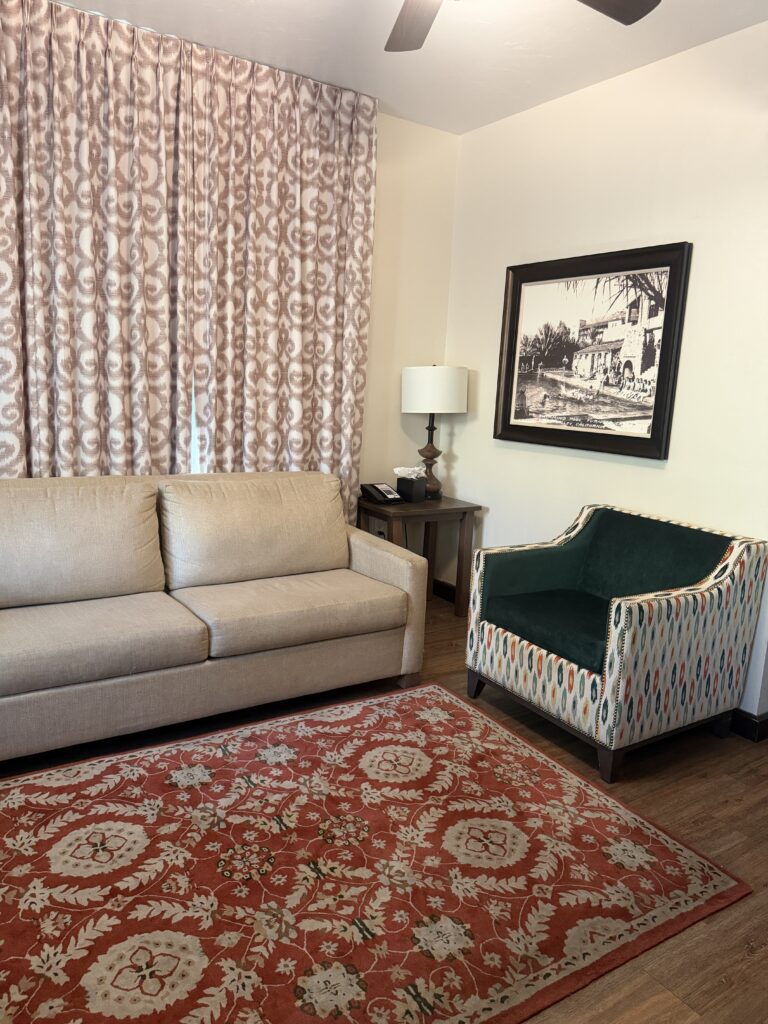
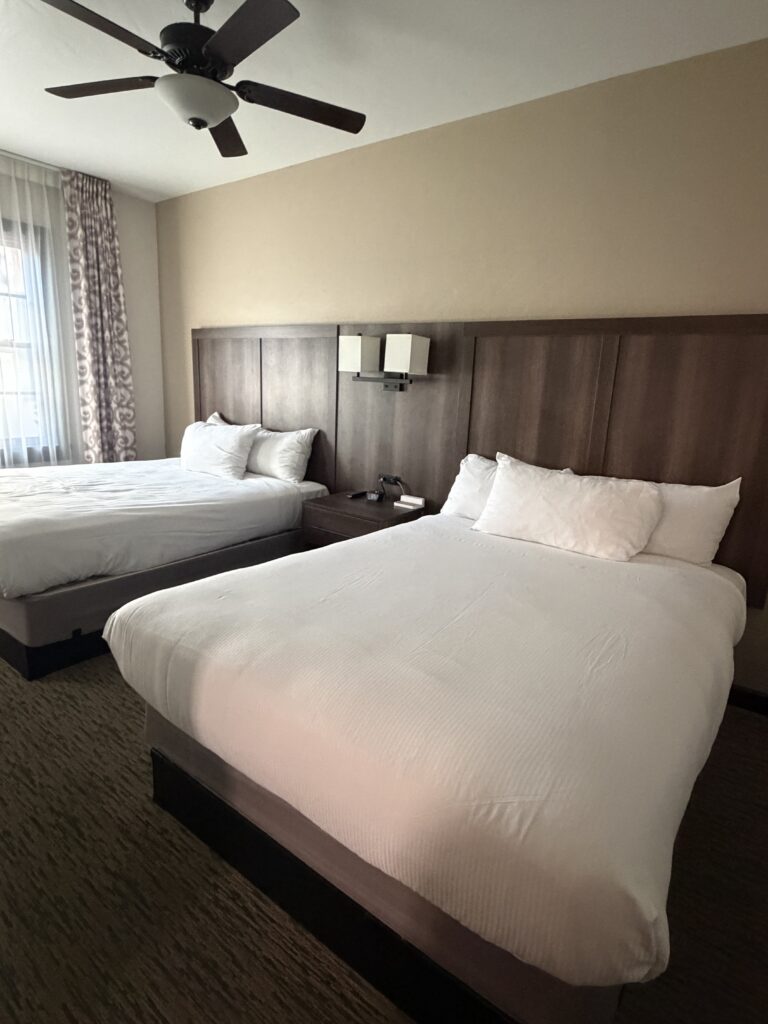
Rooms include standard and deluxe rooms plus the new Cottages, and we stayed in a Cottage for 2 nights. There are 80 Cottages with either two queens or one king, walking distance to Town Square and steps from the golf course. Each is about 400 square feet with a separate bedroom and living area, a front porch, mini fridge, coffee maker and flat-screen TV, and the king Cottages add a queen sofa bed. Ours was cute and spacious, the perfect home base for exploring the park. Check-in is 4 pm and check-out is 11 am.
Town Square
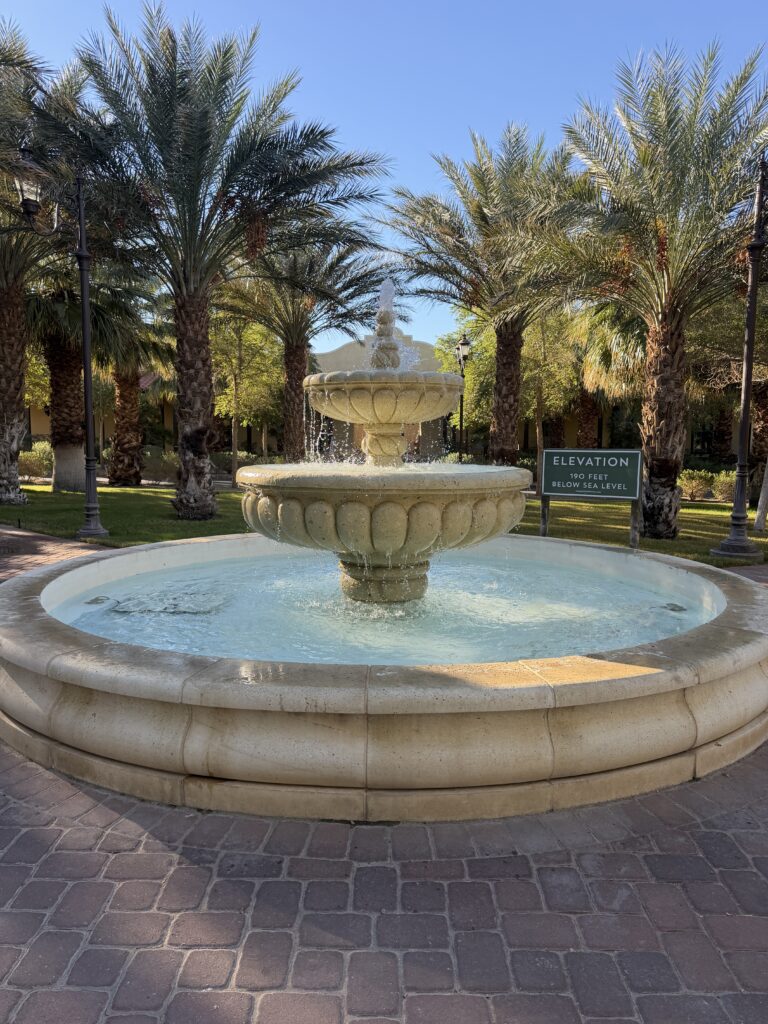
The Town Square is the center of The Ranch, built in Spanish Colonial Revival style during the resort’s big renovation that wrapped up in 2018. It has a fountain, palm trees, Town Hall (where you check in), the Last Kind Words Saloon, the 1849 Buffet, Coffee & Cream and the General Store, all within a short walk of the Cottages.
Borax Museum
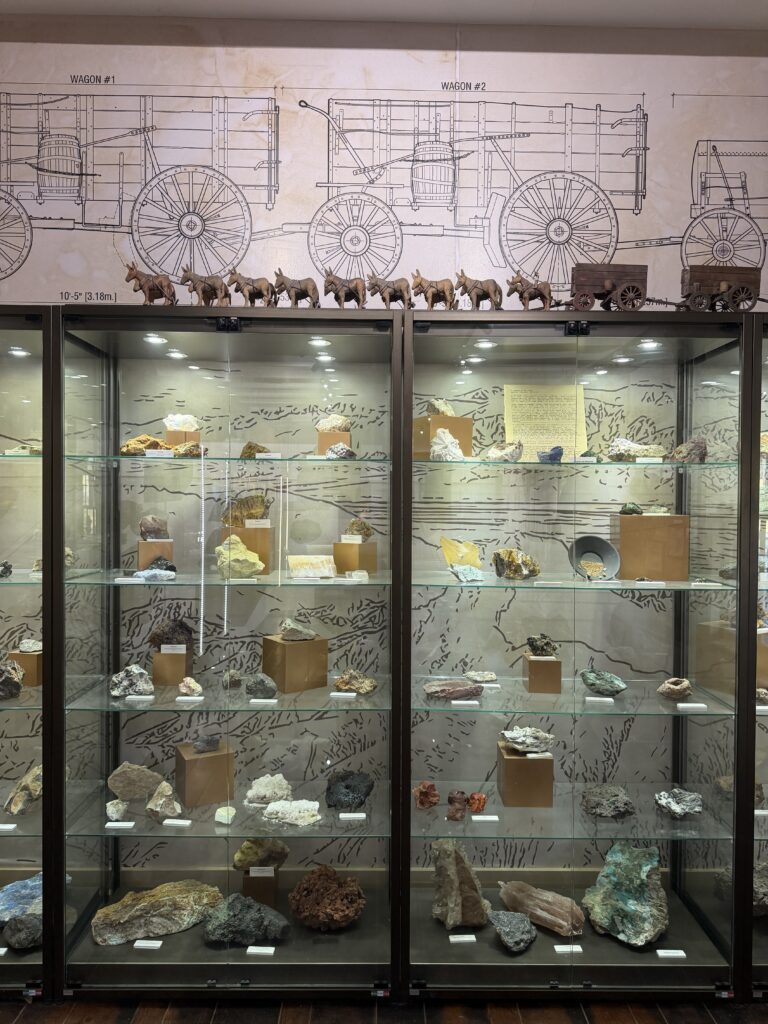
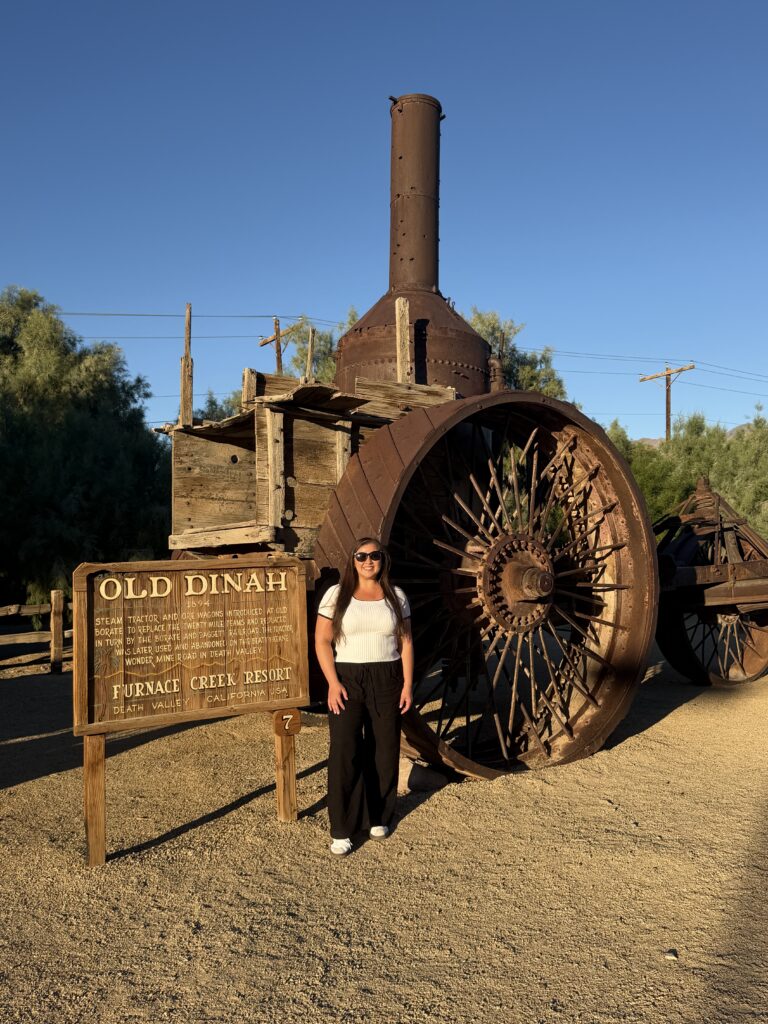
Don’t skip the free Borax Museum. It’s in the oldest building in Death Valley, built in 1883 by F.M. “Borax” Smith, founder of the Pacific Coast Borax Company. It originally stood in Twenty Mule Team Canyon as an office, bunkhouse and ore-checking station for miners, and it opened as a museum here in 1954. Inside are mineral samples and borax mining exhibits, and out back is a yard of historic mining and transportation equipment, including the Old Dinah steam tractor.

Pool, Courts and the Furnace Creek Stables
- Spring-fed pool: stays around 87 degrees and is open 8 am to 11 pm for both Inn and Ranch guests. Not staying here? Day visitors can buy a pool pass at The Ranch registration desk.
- Courts and games: tennis, basketball and volleyball courts, horseshoe pits, a playground, communal fire pits, a putting green and a small driving range.
- Furnace Creek Golf Course: the lowest-elevation golf course in the world at 214 feet below sea level.
- Jeep rentals: if you want to explore the park’s backroads in a 4×4.
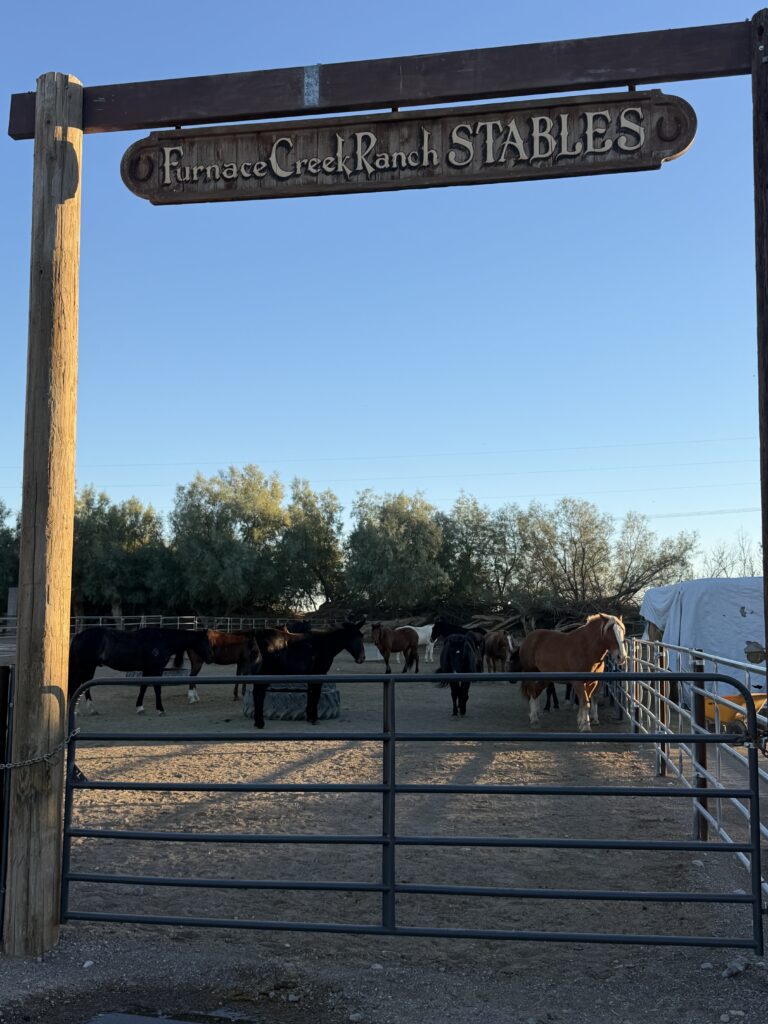
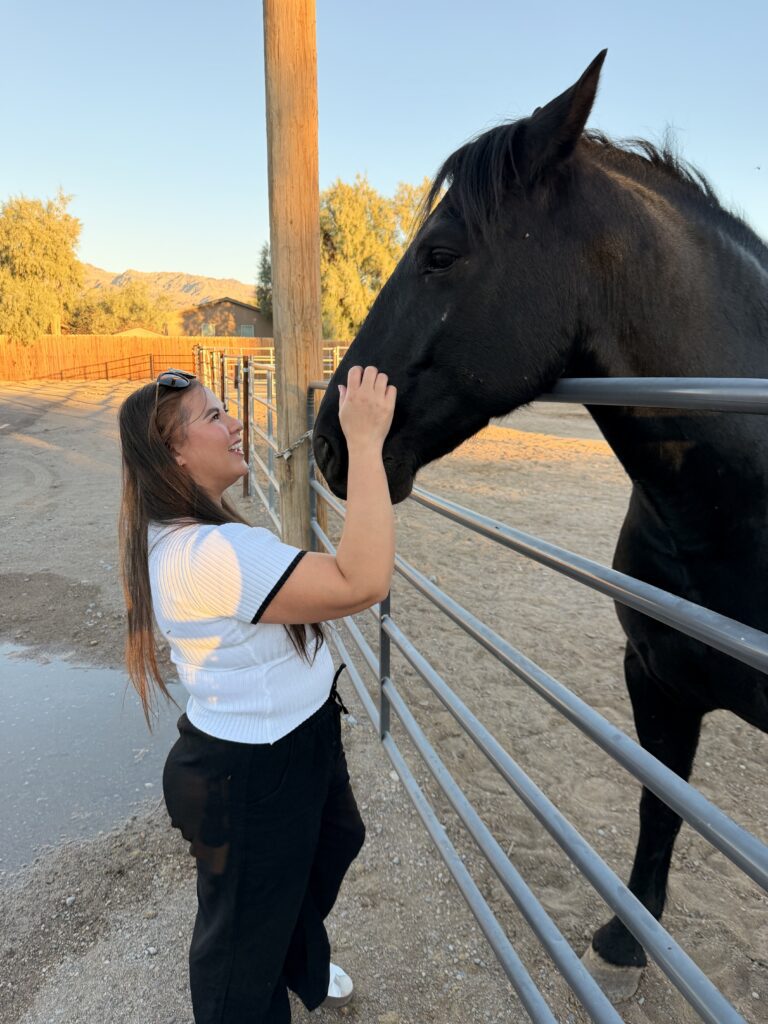
- Furnace Creek Stables: right on the property. We stopped by to meet the horses before our ride the next day.
Dinner at The Last Kind Words Saloon
Dinner the first night was at The Last Kind Words Saloon, named after Larry McMurtry’s 2014 novel about Wyatt Earp and Doc Holliday. It feels like a saloon out of a classic Western, with wagon wheel chandeliers, a stamped tin ceiling, 1920s Navajo rugs and saddles, longhorn skulls, wanted posters and a big dark cherry wood bar. The menu is hearty American: bison burgers, pork ribs, flat iron steak and a 36 oz tomahawk ribeye. Saira had the flat iron steak and I had the American bison burger.
Star Party Under Dark Skies
After dinner we went to a star party hosted by the Las Vegas Astronomical Society. The Ranch hosts star parties with them, and the National Park Service also runs ranger-led night sky programs and a Dark Sky Festival. If you’re stargazing on your own, rangers’ top spots are the Mesquite Flat Sand Dunes, Harmony Borax Works (about a mile north of Furnace Creek) and Badwater Basin.
Squad Tip: Check the Moon Phase
The darker the moon, the more stars you’ll see. Plan your stargazing night close to a new moon, or book a moonlight horseback ride if you’re there near a full moon.
Day 2: Sunrise to Sunset in Death Valley
Day 2 was our big sightseeing day, and staying in Furnace Creek meant most stops were under an hour away.
Zabriskie Point at Sunrise
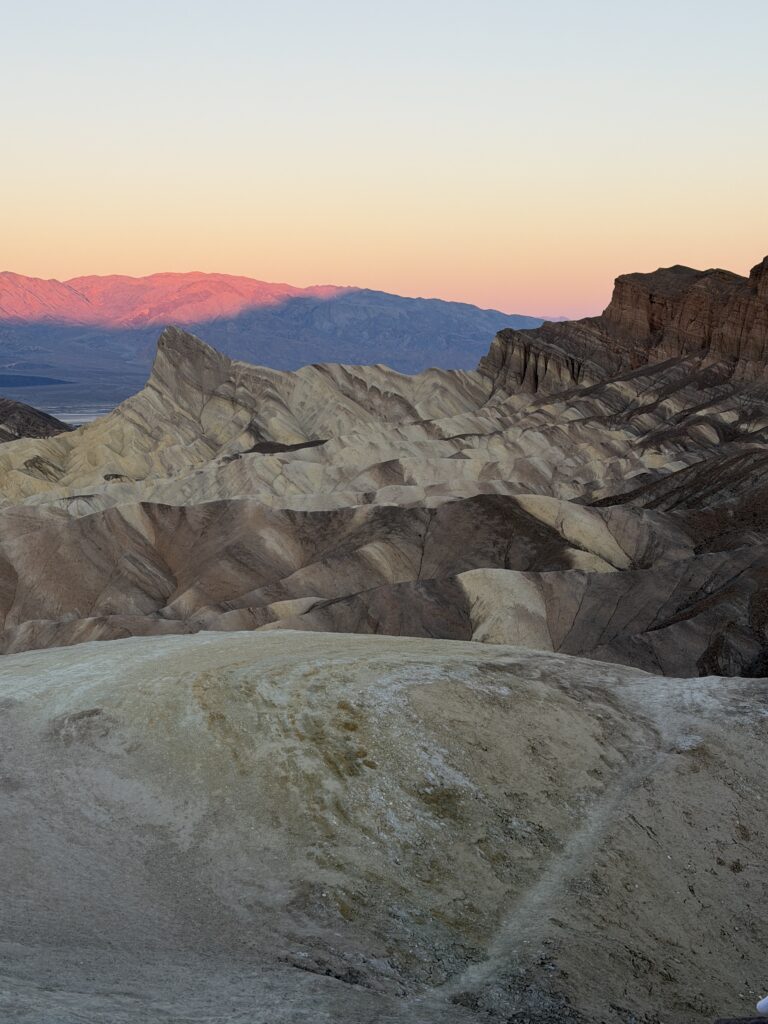
Zabriskie Point is only an 8-minute drive from The Ranch, and it’s the most famous viewpoint in the park. Sunrise was around 6:15 am when we went, and the golden badlands of the Furnace Creek formation light up as the sun comes over the mountains. It’s named after Christian Zabriskie, a VP and general manager of the Pacific Coast Borax Company, which built the overlook in the late 1920s so visitors could see Manly Beacon, the tall peak in the middle of the badlands.
Squad Tip: Grab Coffee on the Way
Coffee & Cream at The Ranch opens at 6 am, so you can grab a Peet’s coffee before sunrise. We came here every morning for drip coffee and a caramel macchiato, and one morning we got breakfast burritos too.
Twenty Mule Team Canyon
Next we took the short scenic drive through Twenty Mule Team Canyon, a 2.7-mile, one-way unpaved loop off Highway 190 through colorful badlands. It’s fine for standard cars, but no RVs or trailers. It’s named for the twenty-mule teams that hauled borax-filled wagons out of the valley.
Dante’s View
About 30 minutes from Twenty Mule Team Canyon, Dante’s View sits at about 5,475 feet on top of the Black Mountains. From here you can see Badwater Basin, the lowest point in North America, and Telescope Peak, the highest point in the park at 11,049 feet, at the same time. The road up is 13 miles with tight curves at the top, and vehicles over 25 feet aren’t allowed.
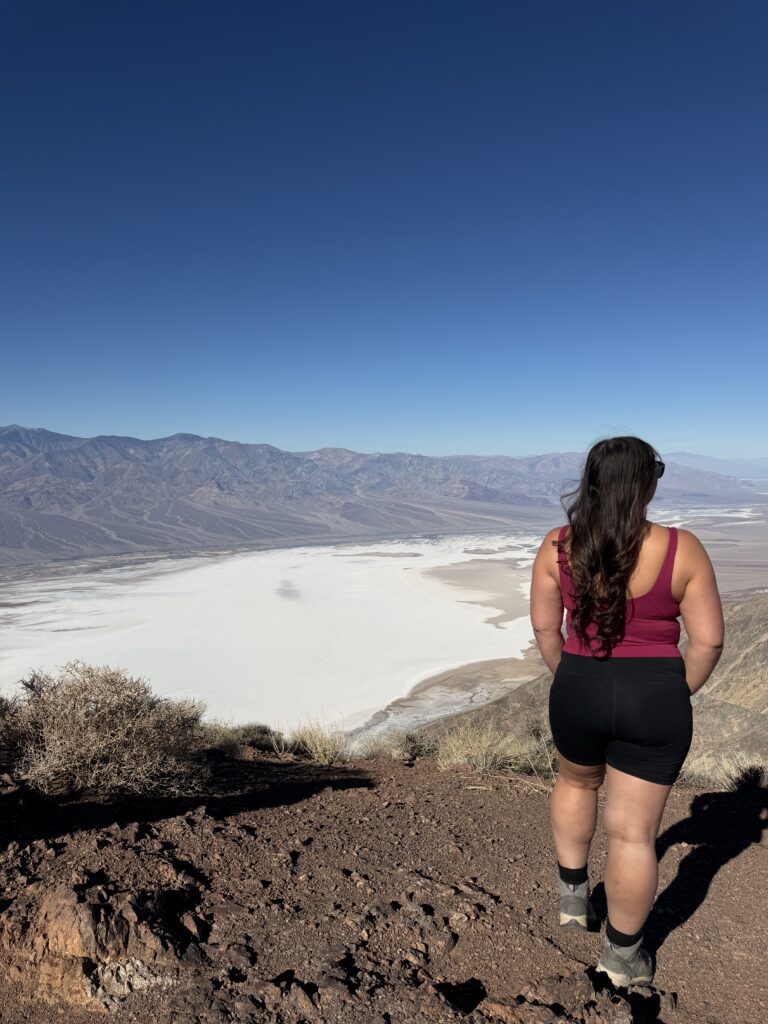
Squad Tip: Bring a Jacket to Dante’s View
It’s much colder and windier up here than on the valley floor, especially early in the day. Pack layers. Our day-hike layers and gear are on our Hiking Must-Haves list.
Devil’s Golf Course
Devil’s Golf Course is a sea of jagged salt spires, about 47 minutes from Dante’s View. The salt is almost pure table salt left behind when an ancient lake evaporated, and wind and rain have carved it into sharp points. The name comes from an early park guidebook that said only the devil could play golf on it. Heads up: the gravel road is often closed after rain.

Badwater Basin
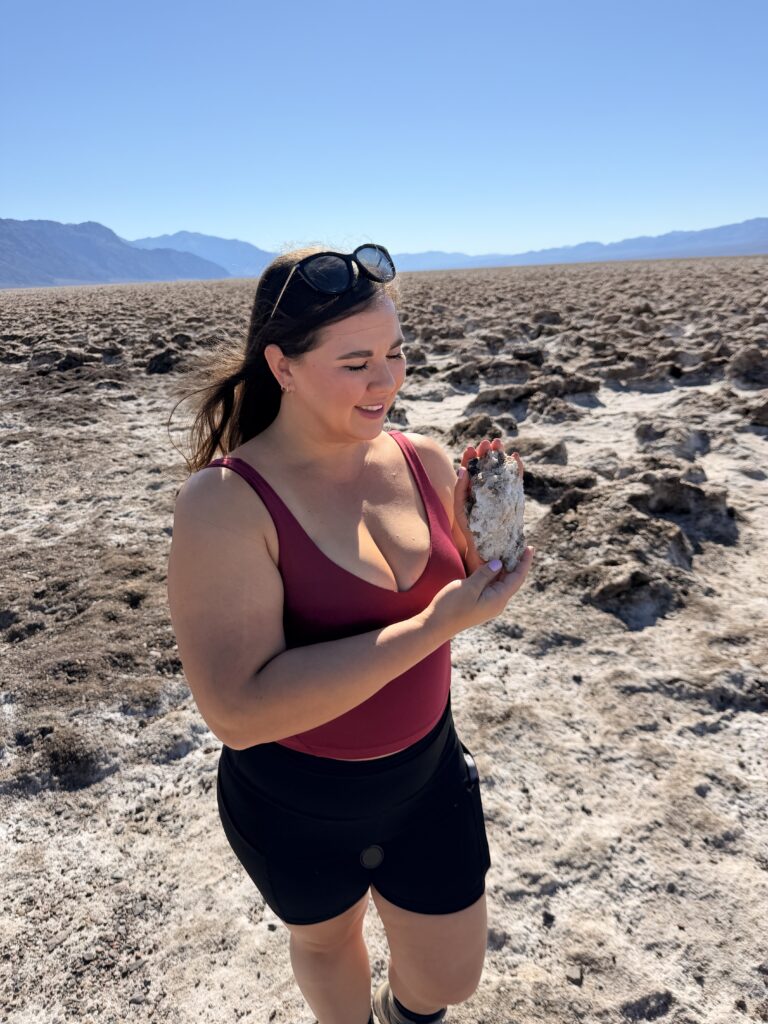
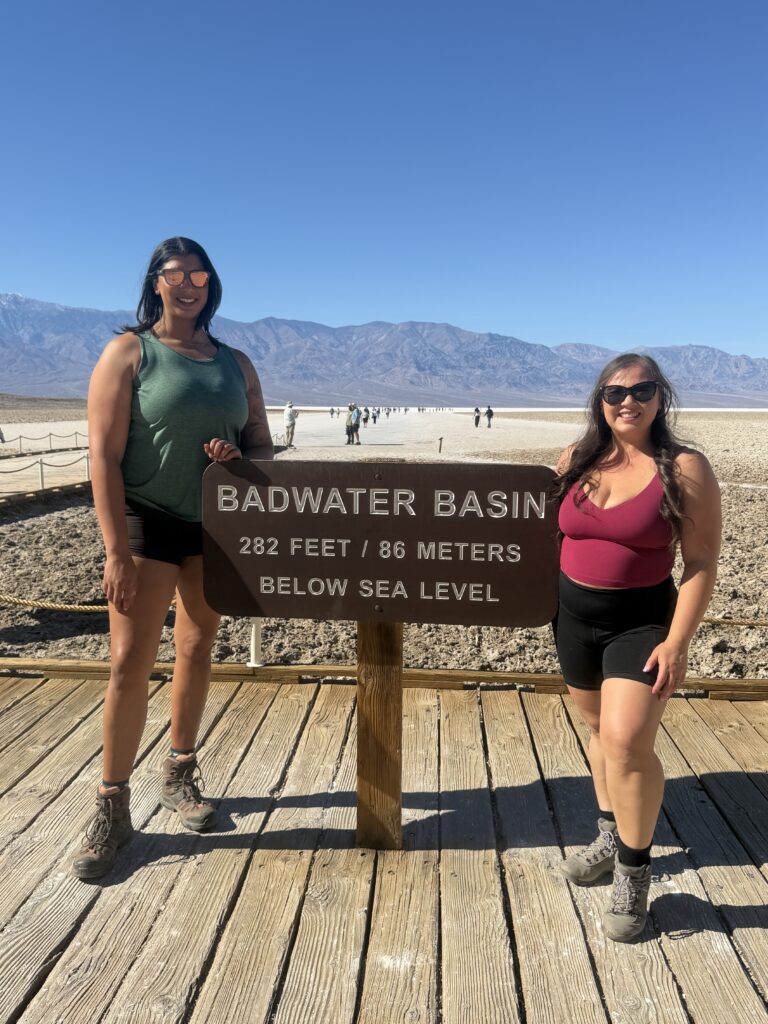
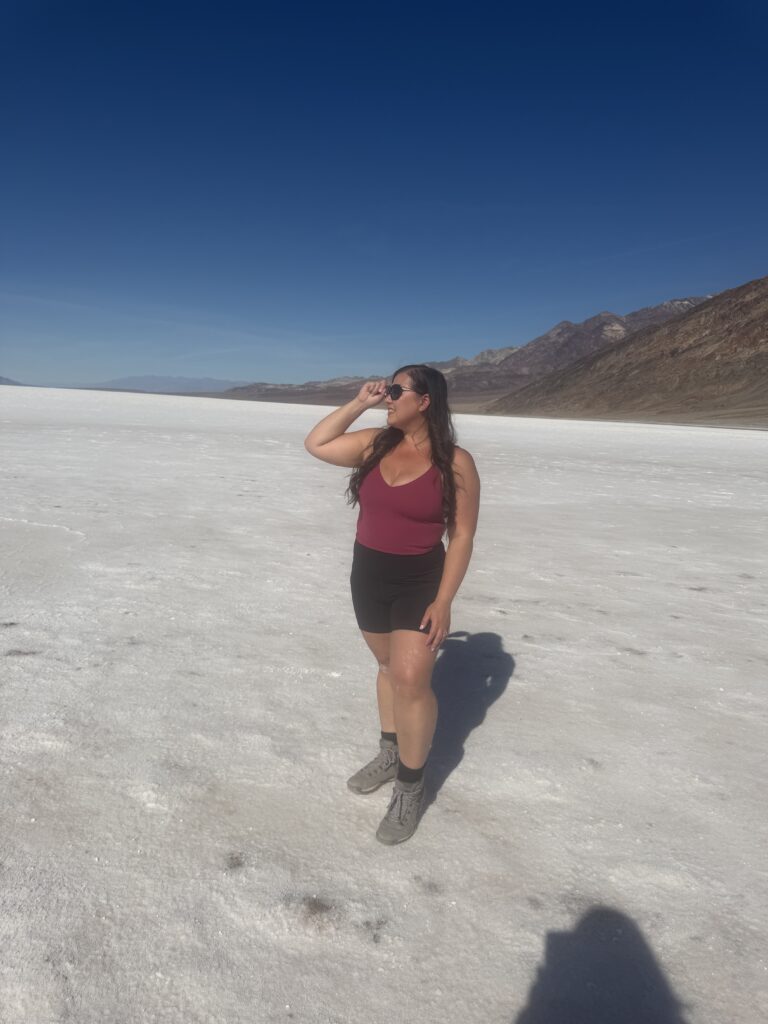
Just 6 minutes away is Badwater Basin, 282 feet (86 meters) below sea level and the lowest point in North America. The salt flats cover nearly 200 square miles, and the ground cracks into the polygon salt formations Death Valley is famous for. The name comes from a story about an early surveyor whose mule refused to drink from the pool here. The water isn’t actually bad, just very salty. Look up at the cliffs behind the parking lot for the “sea level” sign to see just how low you are.
Artists Drive and Artists Palette
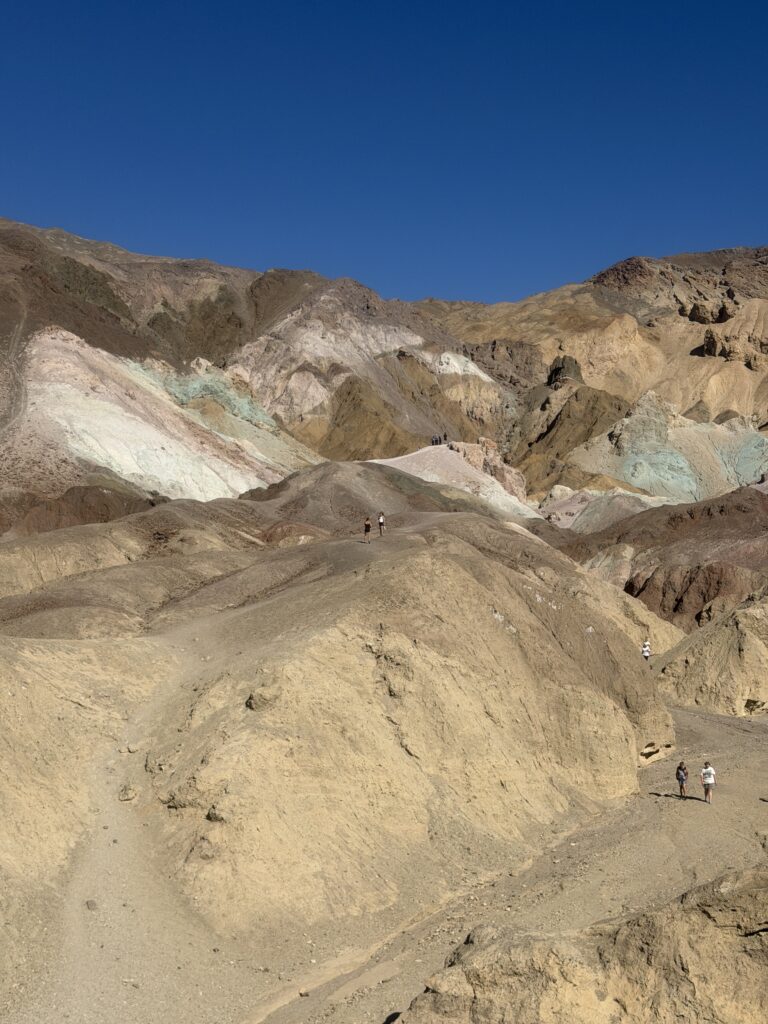
Artists Drive is a 9-mile, one-way road (south to north) through eroded, colorful desert hills, and it’s great at golden hour. Plan about 1.5 hours round trip. Stop at Artists Palette for the best colors: iron makes the reds, pinks and yellows, mica makes the greens and manganese makes the purples. For a short walk, try the Artists Palette Overlook trail.
Mesquite Flat Sand Dunes
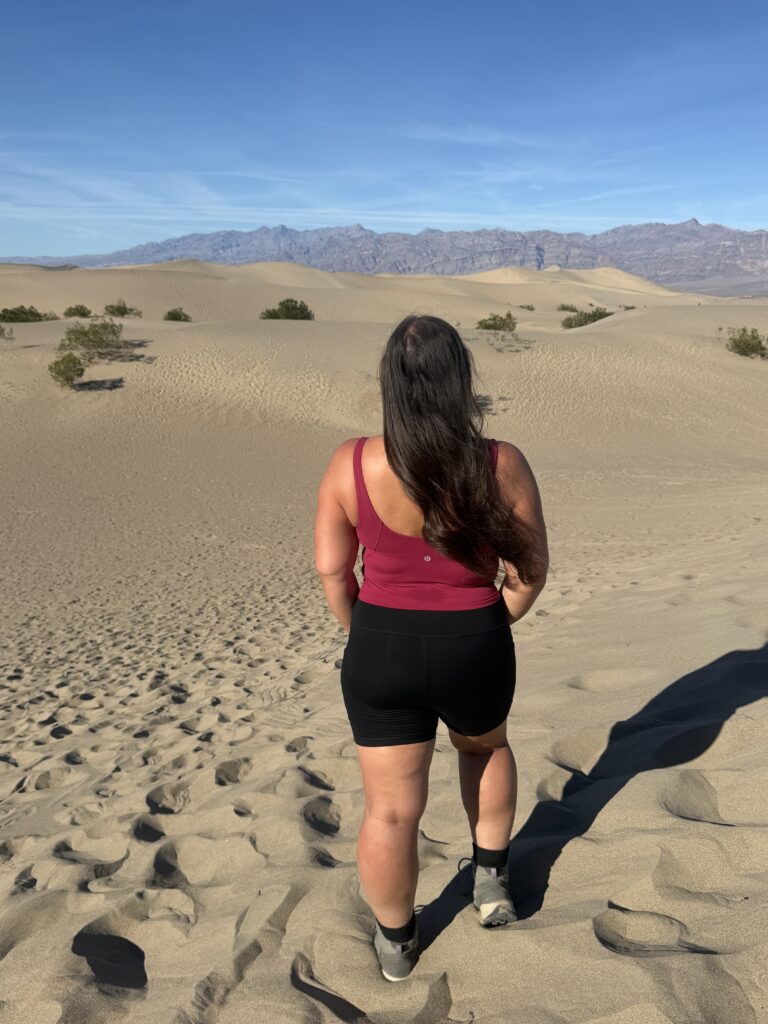
Mesquite Flat Sand Dunes are the largest dune field in the park, with crescent, linear and star-shaped dunes. There’s no official trail, so you can wander wherever you want (the Mesquite Flat Sand Dunes trail out to Star Dune is about 2.3 miles). This is where R2-D2 and C-3PO wander Tatooine in the original Star Wars, and it’s great for sunset and stargazing.
Sunset Horseback Ride at Furnace Creek Stables
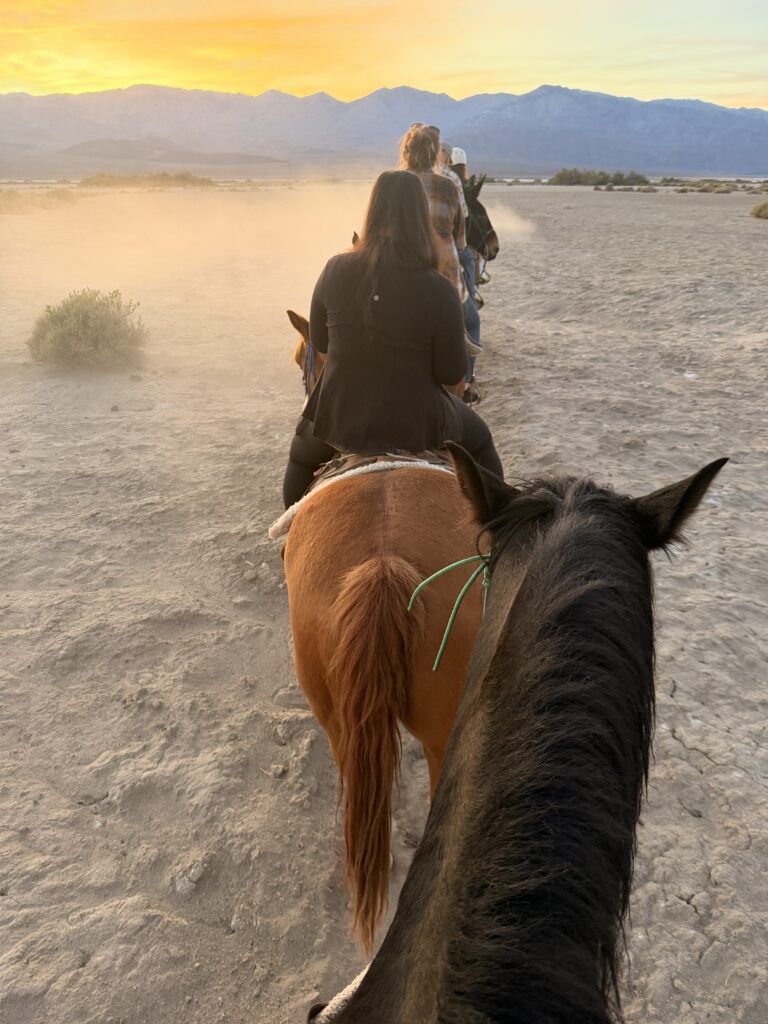
The highlight of our trip was the 1-hour sunset ride with Furnace Creek Stables. My horse was Ace and Saira rode Ragnar, and we headed out onto the valley floor as the sky turned gold. They offer 1- and 2-hour guided trail rides (the 2-hour ride goes into the foothills of the Funeral Mountains), plus wagon and carriage rides and moonlight rides on the nights around a full moon.
Squad Tip: Book Your Ride Ahead of Time
The stables are seasonal, open October through the second Sunday in May, and rides fill up. Reserve before you go.
Dinner and Drinks at the Oasis Lounge at The Inn
We ended the day at the Oasis Lounge at The Inn at Death Valley, next to the Inn Dining Room. It’s filled with Western art, including original paintings and bronze sculptures, and serves signature cocktails and small plates from 3 pm to 9 pm. Dates are a Death Valley tradition: The Inn has served its house-baked date bread since the 1930s, and the date shakes are a must. We ordered the ahi tuna poke, the kale and date salad with chicken, pasta de hongos, a prickly pear margarita, an old fashioned, an espresso martini and the Death Valley mudslide pie.
Day 3: General Store, Mosaic Canyon and the Drive Home
Breakfast and Souvenirs at the General Store
After one last Coffee & Cream run, we grabbed breakfast at the General Store in Town Square. It has souvenirs, gifts, groceries, camping supplies and an ATM, plus The Inn’s famous date bread, and there’s a microwave inside to heat up breakfast. We picked up an ornament, stickers, magnets and a tote before checking out at 11 am.
Mosaic Canyon Hike

On the way out we hiked Mosaic Canyon (3.6 miles round trip, 990 feet of elevation gain). The trailhead is at the end of a 2-mile gravel road near Stovepipe Wells, and about a quarter mile in, the canyon narrows into polished marble walls. It’s named for the mosaic-looking rock in the walls, made of broken pieces of rock cemented together. It took us about two hours at an easy pace, with a few spots where you climb up the rock. You’ll know you’ve reached the end at a 25-foot rock wall, and skip this hike if there’s any chance of rain, since the canyon can flash flood.
Ubehebe Crater and the Sailing Stones
We skipped Ubehebe Crater (say it YOU-bee-HEE-bee) this time, because it would have added about two hours of driving before our 6-hour drive home. It’s first on our list for next time, along with the Racetrack Playa and its mysterious sailing stones. You’ll need a high-clearance vehicle to reach the Racetrack.
Want every stop, drive time and Squad Tip mapped out? Grab our Death Valley itinerary, and browse our Death Valley tours on Viator if you’d like a guide.
Where to Stay in Death Valley
We’d stay at The Ranch at Death Valley again. Being inside the park at Furnace Creek put most of our stops within an hour’s drive, our Cottage gave us room to spread out, and we could walk to coffee, dinner and the stables. Here are two other options, depending on your budget.
The Inn at Death Valley (Luxury Option)
The Inn at Death Valley is the luxury, Old Hollywood-style hotel. The Pacific Coast Borax Company opened it on February 1, 1927 with 12 rooms, and it’s now a AAA Four Diamond hotel where Clark Gable and Carole Lombard once honeymooned. Rooms include kings, suites, a pool bungalow and the new 500+ square foot Casitas in the palm gardens, and amenities include a spring-fed pool, The Wellness Sanctuary spa, pickleball and tennis courts, a rooftop stargazing deck, the Inn Dining Room and the Oasis Lounge.
Staying Outside the Park
If the park is booked up, Pahrump, Nevada is the closest bigger town. Try the Holiday Inn Express or the K7 Bed and Breakfast, but plan for more time in the car.
Where to Eat in Death Valley
- Coffee & Cream (The Ranch): Peet’s coffee, lattes, matcha, cold brew, baked goods and breakfast burritos. Opens at 6 am.
- The Last Kind Words Saloon (The Ranch): Western saloon vibes and hearty plates like bison burgers, ribs and a 36 oz tomahawk ribeye.
- 1849 Buffet (The Ranch): the buffet option in Town Square.
- Oasis Lounge (The Inn): cocktails and small plates from 3 to 9 pm. Order a date shake and anything with the house date bread.
- General Store (The Ranch): grab-and-go breakfast, snacks and groceries, with a microwave inside.
Travel Tips for Death Valley
- Fly into Las Vegas (LAS): it’s about 2 to 2.5 hours to Furnace Creek. Watch for cheap fares with Thrifty Traveler Premium and use code TSP for $20 off your first year.
- Rent a car: there’s no public transportation to or around the park.
- Go October through May: summer temperatures often top 120°F. If you go when it’s warm, start your day early.
- Fill up first: gas and food are limited, so fill your tank and bring plenty of water and snacks.
- Download maps: cell service is spotty, so download offline Google Maps and offline AllTrails maps before you arrive.
- Pack layers: Dante’s View is much colder and windier than the valley floor, especially at sunrise. For Mosaic Canyon and the dunes, we pack a hydration pack, trekking poles and a headlamp from our Hiking Must-Haves list.
- Book horseback rides early: the Furnace Creek Stables are open October through the second Sunday in May.
- Book tours ahead: if you’d rather have a guide, browse our Death Valley tours on Viator.
- What we’d add next time: Ubehebe Crater and the Racetrack Playa’s sailing stones, which we skipped to save driving time.
Keep Exploring California’s National Parks
Death Valley pairs well with the rest of California’s desert and mountain parks, and with a few days in Las Vegas.
- Plan a bigger road trip with The Ultimate National Parks in California List.
- Pair Death Valley with 2 Days of Joshua Tree’s Best Hikes & Scenic Stops, the other big desert park in Southern California.
- Flying into Vegas? Death Valley made our list of 11 Cool Day Trips from Las Vegas.
- More parks you can enjoy without big hikes: Easy National Parks to Visit – No Hiking Required.
- More California ideas: 10 Amazing Places to Visit in California.
Related Episodes
Listen to all of our national park trip episodes on Spotify for more inspiration, including our trips to other desert parks.
Death Valley FAQ
How many days do you need in Death Valley?
3 days and 2 nights is the sweet spot if you stay inside the park: enough to see Zabriskie Point, Badwater Basin, Artists Drive and the Mesquite Flat Sand Dunes, with time left for a horseback ride, stargazing and a hike like Mosaic Canyon.
When is the best time to visit Death Valley?
October through May. Summer temperatures often go over 120°F, so if you visit in warmer months, start very early and avoid midday hikes.
Where should you stay when visiting Death Valley?
Stay inside the park at The Oasis at Death Valley in Furnace Creek. The Ranch at Death Valley is the casual, family-friendly option and The Inn at Death Valley is the luxury option, and both cut way down on driving.
What is the closest airport to Death Valley?
Harry Reid International Airport (LAS) in Las Vegas is the closest major airport, about 2 to 2.5 hours from Furnace Creek. You’ll need a rental car, since there’s no public transportation to or in the park.
Is Death Valley good for stargazing?
Yes. Death Valley is a Gold Tier International Dark Sky Park, the highest rating there is. Rangers recommend the Mesquite Flat Sand Dunes, Harmony Borax Works and Badwater Basin, and nights close to a new moon are best.
Episode Transcript
0:02 Discovering Death Valley: Facts, History, and Film Sites
Welcome to the Travel Squad podcast where adventure meets inspiration where your host I’m Brittanie.
0:07 I’m Kim.
0:08 And I’m Jamal. Together, we explore international destinations, hike epic national parks, and share unforgettable travel experiences with you, one passport stamp at a time.
0:19 Our mission is to inspire you to travel by showing you how you can make it work, no matter your budget, schedule, or experience level.
0:26 We bring you along so that you can laugh, get excited, and start planning your own trip.
0:31 So grab your ticket and your passport.
0:33 And don’t forget your travel insurance.
0:35 And get ready to embark on a new adventure with us around the globe. Hey, squaddies, welcome to this week’s episode of Just the Tip. Today you have me, Brittanie, as your host and I’m taking to Death Valley National Park in California.
0:51 If you’ve been with us for a while, you might remember that we actually did a episode on Death Valley way, way, way back in episode 23, which was back in 2019. And that was just a quick one night, Saturday, Sunday, just really quick weekend trip.
1:07 And we stayed in Pahrump, but this time I decided to spend more time in the park. We spent two nights and we did it over 3 days. And we actually stayed inside the National Park. And so we saved so much time instead of having to travel to and from Pahrump.
1:24 This time I did it with a friend, a girlfriend, Saira. She’s been on a few other episodes that I’ve talked about. And I just feel like it made such a difference staying in the park versus staying outside of the park. But let’s talk a little bit about Death Valley. Death Valley is known as the hottest, driest and lowest National Park in the country, and it’s also the largest National Park in the lower 48 states.
1:46 It’s about 3.4 million acres. It only gets about two inches of rain every year. Death Valley became a National Monument in 1933 and a National Park in 1994. It holds the record for the hottest temperature ever recorded on Earth.
2:02 It’s also home to Badwater Basin, the lowest point in North America at 282 feet below sea level. From Dante’s view, you can see Badwater Basin and Telescope Peak, which towers at 11,049 feet, and you can see them at the same time. So you could see the lowest point in North America and the tallest peak in the park, which is pretty cool.
2:21 It’s also one of the darkest places in the country, and in 2013, it was named a Gold Tier International Dark Sky Park, which is the highest rating there is. The park has a lot of history, so a lot of what you see in the park ties back to Borax. In the late 1800s, Borax was mined here and hauled out by 20 mule teams, which is where the famous 20 Mule Team Borax brand comes from.
2:43 The Pacific Coast Borax Company later went into tourism and built the inn in 1927 and pushed for Death Valley to become a National Park. That’s why so many places have Borax names like Zabriski .20, Mule Team Canyon, and Harmony Borax Works.
2:59 I’m not a Star Wars fan, but I know a lot of people who are. And there are some scenes from the original Star Wars that were filmed here, including at Mesquite Flat Dunes Artist Drive in Dante’s View. So now let’s get into some tips.
3:12 Practical Advice for Your Death Valley Adventure
We drove from San Diego because it’s about a five and 1/2 hour to six hour drive. But if you’re not from a drivable distance, you’re going to fly into Las Vegas. Harry Reid International Airport in Las Vegas is going to be your closest airport and to get to Death Valley from the airport, it’s about a 2 to 2 1/2 hour drive from Furnace Creek.
3:34 One of our favorite ways to find cheap flights to Vegas and everywhere else is Thrifty Traveler Premium. They send you alerts for the best deals on cash, fares, points, and miles from your home airport so you could book for way less. So go to thriftytraveler.com/premium and use our promo code TSP to get $20 off your first year subscription.
3:53 Another tip that we have for you is to get a rental car. There’s no public transportation to or around the park. You’ll also want to go between October and May Summer temperatures often go over 120 degrees, so if you do go when it’s warm, start your day early.
4:10 And that’s why we decided to go in November because the weather was going to be much more tolerable while we were there. The lows were in the 50s for early mornings and late nights and it got into the mid 70s low 80s while we were there. I kind of already mentioned this tip, but stay inside the park if you can.
4:28 The stops are spread out and you’ll drive a lot either way, so staying in the park cuts back on the driving time. And I recommend staying at the Oasis at Death Valley and I’ll get into more about our stay once we get there. Death Valley is a National Park that you can actually horseback ride in.
4:45 And if you do want a horseback ride while you’re here, just book rides ahead of time. The Furnace Creek Stables are open seasonally from October through the 2nd Sunday in May and they book up quickly so make sure to reserve in advance while you’re in the park. Gas and food are very limited, so make sure you fill up before you go and you bring in plenty of water and snacks.
5:05 And cell service is very spotty. So download offline Google Maps before you get there and download offline trail maps from All Trails if you plan to do any hiking in the park. Another great tip is to pack layers. Dante’s view sits at 5475 feet and it’s much more colder and windier than at the valley floor, especially at sunrise.
5:26 And it’s a great place for sunrise. So just keep that in mind that you’re packing layers. And then if you do want to stargaze, check the moon phase. The darker the moon soon, the more stars you’re going to see. All right, let’s get into it.
5:38 Arriving at The Ranch and Night Sky Wonders
So we did a trip Friday through Sunday and we left San Diego at around 8:00 AM and we ended up arriving to the park around 3:00 PM. We did stop for lunch and we did have some other breaks that we did in between. So that’s as long as it took us.
5:54 And immediately we went to check in our accommodation. We were staying at the Ranch at Death Valley. It’s part of the Oasis at Death Valley, which includes 2 hotels and I just really quickly want to go over the difference between the two. So we have the in at Death Valley and the Ranch at Death Valley.
6:10 They sit on private land inside the Park at Furnace Creek and it’s right next to the National Park Visitor Center. The In at Death Valley is the luxury old Hollywood style hotel. It was built by the Pacific Coast Sporox Company and originally opened in 1927 with just 12 rooms.
6:27 Now it’s this luxury, beautiful triple A4 diamond hotel and it just screams old money. They have really beautiful rooms here. They have King Room suites, a pool bungalow and they have new 500 plus square foot casitas in the Palm gardens.
6:43 They also have on site a spring fed pool, a spa, pickleball and tennis courts, a rooftop deck for stargazing and the in dining room and Oasis lounge. We stayed at the ranch at Death Valley. The ranch is more casual, adventure focused, it’s more family friendly and it was originally the headquarters for the Pacific Coast Borax Company and it first opened a guest in 1933, the same year President Hoover signed in the proclamation creating Death Valley National Monument.
7:14 At the ranch. They have standard and deluxe rooms, plus they have new 400 square foot cottages and we stayed at one of the cottages with two queen beds. The whole resort went through a major renovation that was completed in 2018. And so it has this new beautiful town square in a Spanish Colonial Revival style with a fountain, palm trees, restaurants and a general store.
7:35 You literally feel like you’re in a little village while you’re staying here. So we ended up staying in the cottage for two nights. The cottages are the newest addition to the ranch. There’s 80 of them. They’re cottage style rooms with either 2 Queens or one king, and they’re walking distance to everything that’s on the ranch.
7:51 And the ranch has a general store, it has several different restaurants, a Tavern and a saloon, a like buffet style restaurant, ice cream parlor, there’s a post office on site, there’s a golf course, there’s a pool, there’s a tennis courts, basketball courts and stables right on property so you can see the horses.
8:11 So when you check into the cottages, you’re going to see that there’s seating areas right on the front porch. You’re going to enter in through the door and then there’s going to be a sitting area for you to enjoy. There was a small left seat and then a chair. There was also a microwave and mini fridge inside the room with the TV.
8:28 Then the bathroom was just right past that. And then you go further down the hall and then there was the bedroom. I was going with a friend, Cyrus, that we had two queen beds and her cottage. And each cottage has like a different side, so we were staying on the left side, but on the right side there is another room that is basically the identical version of what we had in our room.
8:49 Once we were settled, we decided to go explore the property. We went to check out the pool. The pool is spring fed and it stays 87° all year round. So that’s really nice because at night and in the morning it’s a little chilly. It’s like in the 50s during winter, so or colder perhaps.
9:07 So it was a nice temperature for the pool. We saw the tennis court, we saw the basketball court. And then we actually checked out a museum that they have on site. The museum is called the Borax Museum. It’s housed in the oldest building in Death Valley that was built in 1883.
9:23 And it has old mining equipment and the 20 mule team wagons. So they do have an inside portion that you can explore, but then you can walk around the porch and go into the back and that’s where they have like the steam train and a whole bunch of the wagons and other artifacts that make up the history of this park.
9:44 Then we made our way over to the stables. There are Furnace Creek stables right on property and the horses are just so beautiful. They come right up. If there’s a sign though, that says you know, not to pet or touch the horses. But you can actually book horseback riding rides.
9:59 They have a sunrise ride, a sunset ride, and then they have rides during the day and each ride is one to two hours depending on what you book. They also have on property Jeep rentals if you want to explore the park in a 4 by 4. So there’s a lot going on at the Oasis at Death Valley.
10:16 Once we explore the property, it was getting time for dinner so we decided to have dinner at the last Kind Words Saloon. This saloon feels like you’re walking into a classic western. There’s a wagon wheel, chandeliers, a stamped in ceiling, 1920s Navajo rugs and saddles, Longhorn skulls, wanted posters, and a big dark cherry wood bar.
10:39 So very classic Western theming. They have a hearty American menu with dishes like a bison burger, which is what I got. They have ribs, they have steaks, and everything was really good. My one recommendation for if you’re wanting to eat at the saloon or at the dining room at the inn to make reservations in advance because the wait times can be quite long since there’s such limited selections for eating and restaurants on property or within the National Park.
11:07 It was also kind of busy because this weekend they were having a stargazing party on Friday and Saturday nights right in the campground that was connected to the ranch. So we decided to go first, eat, and then go to the stargazing party.
11:24 The stargazing party was from 7:00 to 10:00 PM and it was hosted by the Las Vegas Astronomical Society. The ranch hosts star parties with them. And what was really cool was when if you didn’t have a red light, there was one that you could borrow. And then there was a line of telescopes on each side.
11:41 And there was probably about 20 different telescopes set up, and each telescope was pointing to different things. So we saw Saturn, we saw the Seven Sisters, saw other stars and constellations, and then when you get to the end of the row, every hour on the half hour, so 738-3930, they were doing guided constellation tours.
12:03 So that was really, really cool. We brought something to sit on so that we could look up and just really enjoy the stargazing experience. But you can enjoy it however you want. If you wanted to just look through the telescope, you could do that as well. And it was open to the public both Friday and Saturday night.
12:19 The National Park does other stargazing events, or you can do stargazing on your own. Some really highly rated stargazing spots are at the Mesquite Flat Sand Dunes, Harmony Borax Works and Badwater Basin. And after we went stargazing, that pretty much concluded our evening Squaddy is if you’re wanting to visit Death Valley, we put together A2 day Death Valley National Park itinerary with all of the information that you need.
12:44 Iconic Sights and a Memorable Sunset Ride
It has the best airport and how to get there, where to stay at the Oasis at Death Valley, and a day by day plan with all the spots we visited, plus drive times, how long to spend at each stop, and squad tips along the way. So you can actually get your copy of our two day Death Valley National Park itinerary at shoptravelsquad.com.
13:03 So going into day two Saturday of our Death Valley trip, we wanted to wake up and watch the sunrise and we decided to watch the sunrise at Zabriski Point. It was only about an 8 minute drive from the ranch at Death Valley and sunrise was at 6:15.
13:19 We always recommend getting to sunrise about 30 minutes prior to sunrise so you can start to see all of the colors change. Zabriski Point is the most famous viewpoint in the park. Here in a park at a little parking area and then you’re going to walk up a a little bit and it overlooks these golden colored band lands of the Furnace Creek Formation.
13:39 This point is actually named after Christian Zabriski, the vice president and general manager of the Pacific Coast Borax Company that I’ve talked about. The company built the overlook in the 1920s so visitors could see Manly Beacon, the tallest peak in the middle of the Badlands.
13:55 We did make a little mistake, and I’ll share this with you guys. So we ended up sitting facing the sunrise because we thought, oh, we’re going to watch the sunrise. But you’re actually not going to be able to really see the sunrise coming above these peaks. So what you actually want to do is you want to sit on the other side facing away from the sun.
14:15 That way you can see the valley below and all of the Badlands start to light up with all of the colors and that’s where you’re going to get your good view. So don’t make the same mistake as us and sit on the right side. We still got to enjoy the view though, so it worked out and that’s OK.
14:32 Afterwards, we ended up going back to the hotel so we can finish getting ready and grab some coffee and breakfast. We got coffee at coffee and cream. It’s right at the ranch. I ended up getting a caramel macchiato. Saira ended up getting just a drip coffee, they pour Peet’s coffee and they have lattes, matcha cold brew, and some baked goods.
14:51 We also got some breakfast burritos here so you can take them to go if you want as well. It opens at 6:00 so they open pretty early, so depending on what time Sunrise is, you might even be able to grab something before you go. Next on our list was to visit the 20 Mule Team Canyon.
15:07 This is a very short scenic drive through the colorful Badlands. The drive’s only 2.7 miles. It’s one way on an unpaved loop off of Hwy. 190. It’s fine for standard cars, but you can’t bring any RV’s or trailers on this path, so just keep that in mind.
15:24 And it’s named for the 20 meal teams that hauled Borax filled wagons out of the valley. After we were done with the scenic drive, we made our way to Dante’s View. Dante’s View was about a 30 minute drive from the Canyon and you go up this windy Rd.
15:40 The road is 13 miles with tight curves at the top so vehicles over 25 feet aren’t allowed up. But once you’re up there, you were greeted with the most beautiful panoramic views, a bad water basin, while you’re about 5475 feet on top of the Black Mountains.
15:58 So you’re basically overlooking the lowest point in North America. And then you have the snow capped mountains in the background, including Telescope Peak, which I mentioned earlier is the highest point in the park. So it’s a little chillier up here. It’s much colder and windier than the valley floor.
16:14 So just make sure you’re dressed appropriately. A lot of people also come here for sunrise, but it’s a little bit more of a trek to get up to Dante’s View. So that’s why we went to Zabriskie Point instead. But if I were to come back, I think I would do sunrise at Dante’s View.
16:29 It would just be a little cold and chilly. While we were up at the top. You could see some spur off trails, so you could either go down a little bit or go up a little bit if you choose to do so. We we went down a little bit and just took some pictures from there and then we went on our way to Devil’s Golf Course.
16:47 These three things that I last just talked about Devil’s Golf Course, Dante’s View and 20 Mule Team Canyon, those are things that we didn’t do the first time I came to Death Valley. So I was really excited to be able to work these things in. Devil’s Golf Course is this sea of jagged salt pieces.
17:04 So there’s a small parking lot for you to park in, and when you get out, you’re going to see what look like rocks or little bolder formations. But as you get close to them, you can see that they’re actually salt crystal formations. The salt is almost pure table salt left behind when an ancient lake evaporated and the wind and rain have carved them into sharp Spires and rock formation.
17:24 So it’s really, really cool. You can walk out into the Devil’s Golf Course. Just be very careful because if you fall and you land on any of these jagged salt formations, you could really get hurt and cut up because they are very sharp. And also just keep in mind that, but this is a gravel road to get out here.
17:42 So sometimes they close this road after a heavy rain. But keep in mind Death Valley only rains about two inches a year on average. So this typically isn’t an issue. Of course, we decided to drive down to Badwater Basin. Badwater Basin is the lowest point in North America.
17:59 It’s 282 feet below sea level, so there is a little platform with a sign that you could see and then you can see the basin behind it and you can actually walk out to those salt formations as well. One quick thing that I want to say is that this is all sun exposed.
18:17 There’s absolutely no shade in this area. And the walk out to bad water basin where you can see the cracks in the ground that make it look like this Polygon salt formations, it’s quite a walk out there. And so make sure you’re bringing sun protection and you’re staying hydrated and you bring your water because it looks close, but it’s farther than you think.
18:40 And it’s really hot and dry out in this area. So the farther that you go out, the better you can see all of the Polygon salt formations because everyone’s kind of walked on that first section, so you can’t really see it as well. And the ground isn’t as white because there’s more dirt mixed in.
18:59 So if you want to really see them, you’re going to have to walk out quite a bit and then get those cool photos with the Polygon salt formations that are there. The salt flats cover nearly 200 square miles and are mostly just table salt, along with calcite, gypsum and Borg racks.
19:15 The name behind Bad Water Basin comes from a story about an early surveyor whose mule refused to drink from the water pool here. The water isn’t actually bad, it’s just very, very salty. But because his mule wouldn’t drink the water, he said it was bad water. And that’s how it got the name Bad Water Basin.
19:32 While you’re standing at the platform in the sign that says you’re 282 feet below sea level, look back towards the parking lot and then look up the Cliff a little bit. They actually do have a sign there that shows you where sea level is, so you have that kind of comparison to refer to, which is really cool.
19:51 After we spent some time at Badwater Basin, we made our way to Artist Drive. It’s a really great place to visit during golden Hour. The colors will really pop more and feel a lot softer and not as washed out by the sun. But we had plans during golden hour, so we went ahead and just did it at this time.
20:09 That we could and what it is is it’s a one way nine mile drive from South to north and it passes through eroded colorful desert hills. There is a stop called artist palette along the way and you can just go to the overlook or there’s a little short hike that you could do as well.
20:27 But what you’ll see are colorful views of these like Badlands and the colors come from different metals oxidizing in the rock. Iron makes the Reds, pinks and yellows. Mica makes the greens and manganese makes the purples, so it’s really cool to see and if you have the opportunity to view it at golden hour, I would recommend doing so.
20:47 From here we then made our way to Mesquite Flat Sand Dunes. Mesquite Flat Sand Dunes are the largest dune field in the park. This dune field includes 3 different types of dunes, Crescent, linear, and star shaped. There’s no official trail at Mesquite Flat Sand Dunes, so you can go out as far as you’d like.
21:04 But again, this is one of these places where you’re completely sun exposed and it’s very difficult to walk in the sand. The sand is very, very soft and you kind of just squish right in. So just keep that in mind. You can wander wherever you want. The tallest dune is called Stardune.
21:21 You can hike out there if you’d like to, but it’s just kind of crazy how it like you’re driving through and you see desert, desert, desert and then all of a sudden you see this huge sand dune field that seems to come out of nowhere. So we went out a little bit farther than most people went, but not super, super far out and just caught some really cool photos us on the sand dunes.
21:42 And then we walked back. And for you Star Wars lovers, this is where one of the famous scenes was shot in the original Star Wars. And this is also a really good spot for sunset and for stargazing. Like I mentioned earlier, after you’re done with Mesquite Flat Sand Dunes, we headed back to the ranch.
21:59 And the reason why we headed back to the ranch was because we ended up booking a sunset horseback ride at Ferns Creek Stables. So they’re located right on the property of the ranch. We just went into our cottage, we changed, and then we walked right out to the stables. I mentioned earlier they offer one and two hour guided trail rides.
22:17 The one hour ride goes out onto the valley floor and the two hour ride goes into the foothills of the Funeral mountains with views of the valley below. Sometimes they also have moonlight rides and I hear that they’re offered on nights before and right after a full moon. I think that would be really cool to do, but we weren’t there at the right time.
22:34 So we did a really beautiful, beautiful one hour sunset ride. My horse was named Ace. He was the smallest horse on property. And then Saira had a horse named Ragnar, who we met the day before because Ragnar really wanted to not follow the rules and poke his head over the fence and he wanted pets.
22:53 So we got to meet him the day before and it was actually while we were admiring Ragnar when Luke, the stable manager, came up and told us all about the rides and how to book them. So that’s when we booked it the day before and then we rode this day. The sunset colors that you see during this ride are absolutely incredible.
23:11 It was really beautiful. The temperature was perfect and there was about seven of us on this beautiful sunset ride. My only complaint about visiting Death Valley in winter, which is obviously the best time to go because of the weather, is at sunset is so early.
23:27 Sunset was at like 4:45, so it was completely dark by like 530 this day and it just makes it feel a lot later than it really is. But after the sunset ride, we decided to go and get ready for dinner. I mentioned earlier that it’s a really good idea to make reservations, and I’ll use this is a great example.
23:44 We made reservations to have dinner at the dining room at the inn the day before. And when we made the reservations, the only time slot left was 845. And we were like, Oh my gosh, that’s so late. We decided to try our luck and to see if we could get into the dining room at the inn any earlier.
24:00 And unfortunately, they couldn’t see this any earlier, but they did tell us that we could eat in the lounge if we wanted and that they served both the lounge menu and the main dining room menu in the lounge. So we decided to do that. If you’re only looking at the lounge menu, they serve signature cocktails and small plates menu, but you can ask for the main dining room menu.
24:19 So we did. We ended up ordering the ahi tuna pokey, the kale and date salad, and we added chicken on that and the paste dejongas, which we also added chicken on, which was really good. We got a prickly pear Margarita that I enjoyed. Saira enjoyed an old fashion.
24:34 And then with dessert, we got espresso martinis and the Meth Valley mudslide pie, which was really good. So we had plenty to eat at the lounge at the end. And then we just ended up missing our true dinner reservation in the dining room.
24:50 So if you wanted to eat in the true dining room, make sure to make a reservation in advance. After this, we decided to go back to our cottage and just call this a night. Day three.
25:01 Mosaic Canyon Hike and Future Death Valley Adventures
Sunday was our last and final day in the park and our travel day back home. So we slept in a little bit and then we grabbed coffee at coffee and cream. We ended up getting breakfast at the general store. They had a selection of like burritos that you could warm up or breakfast sandwiches that you could warm up in the microwave there.
25:19 And then we ended up getting some souvenirs. But the general store has a lot to offer and I wish I knew this the first time we visited Death Valley because they have souvenirs, they have gifts, they have groceries, they have camping supplies, they even have an ATM. So they have everything that you need inside this general store.
25:36 It’s pretty large and has a pretty good selection. Then we checked out of the ranch and headed on over to our hike for the day. We went and hiked Mosaic Canyon. It’s 3.6 miles round trip with a 990 foot elevation gain. The trailhead is at the end of a two mile gravel road near Stovepipe Wells and about 1/4 mile in the Canyon narrows into these really beautiful polished marble walls.
26:01 One thing to keep in mind though is if there is any chance of rain in the forecast, you don’t want to visit there because it could be the site of flash floods and you don’t want to be trapped in a flash flood. The name of the hike, Mosaic Canyon, is named for the mosaic looking rocks in the Canyon walls made of broken pieces of rock cemented together.
26:20 The hike, it was moderately easy in my opinion. You gain the elevation gradually unless you’re climbing over. There are some parts where you do have to climb up the stone and that part can be a little bit challenging. So just keep that in mind if you’re traveling with people with mobility issues or small children and you’ll know you’re at the very end of the hike when you hit a 25 foot Stonewall that you cannot scale over.
26:45 So that’s going to serve as your turn around point. It took us about two hours to do this hike and we took our time with it. We didn’t rush through it or anything like that. It’s really fun. It’s nice. It gives you a different perspective of Death Valley. And we left from here because we did have about a six hour drive home.
27:02 But some other sites that I do just quickly want to mention because when we do come back to Death Valley, these are two that I would like to visit. I would like to see the UB Hebe Crater. It’s just a little bit out of the way and it would have added another two hours of driving onto our day.
27:19 And we were already going to have to drive 6 hours back home. So we decided to skip that. But it does look really cool in photos. And then the sailing stones, which are the stones that move across the desert floor, I would really like to see that. But when I mapped it out, the round trip is like 3 hours there turn back.
27:38 So for a six hour total and you just need her full day to dedicated to something like that. And we just didn’t have that built into our weekend. But those are some things that I would like to see eventually. So squaddies, I hope you’ve enjoyed this episode about Death Valley National Park.
27:54 Thank you so much for tuning into just the tip. Make sure to subscribe, leave a review and follow us on all the socials at Travel Squad podcast and have fun traveling this weekend. Bye, squaddies.




Comments
Comments Off on 3 Days in Death Valley: Sunrise Badlands, Salt Flats & Our Stay at The Ranch