


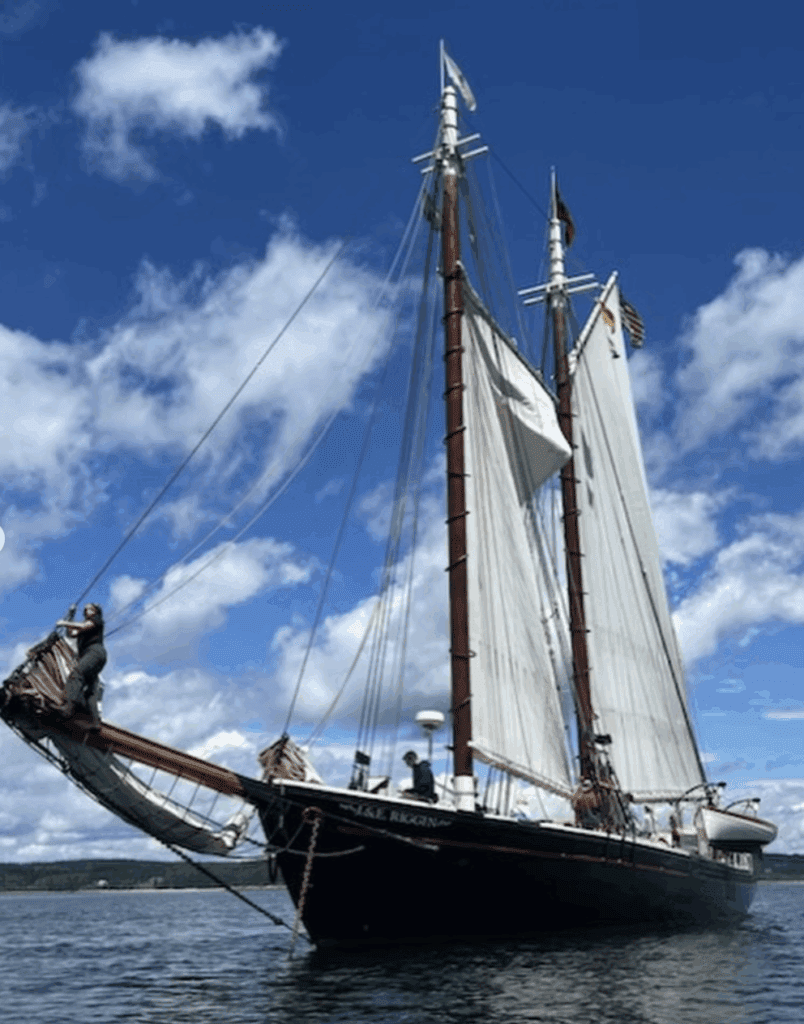
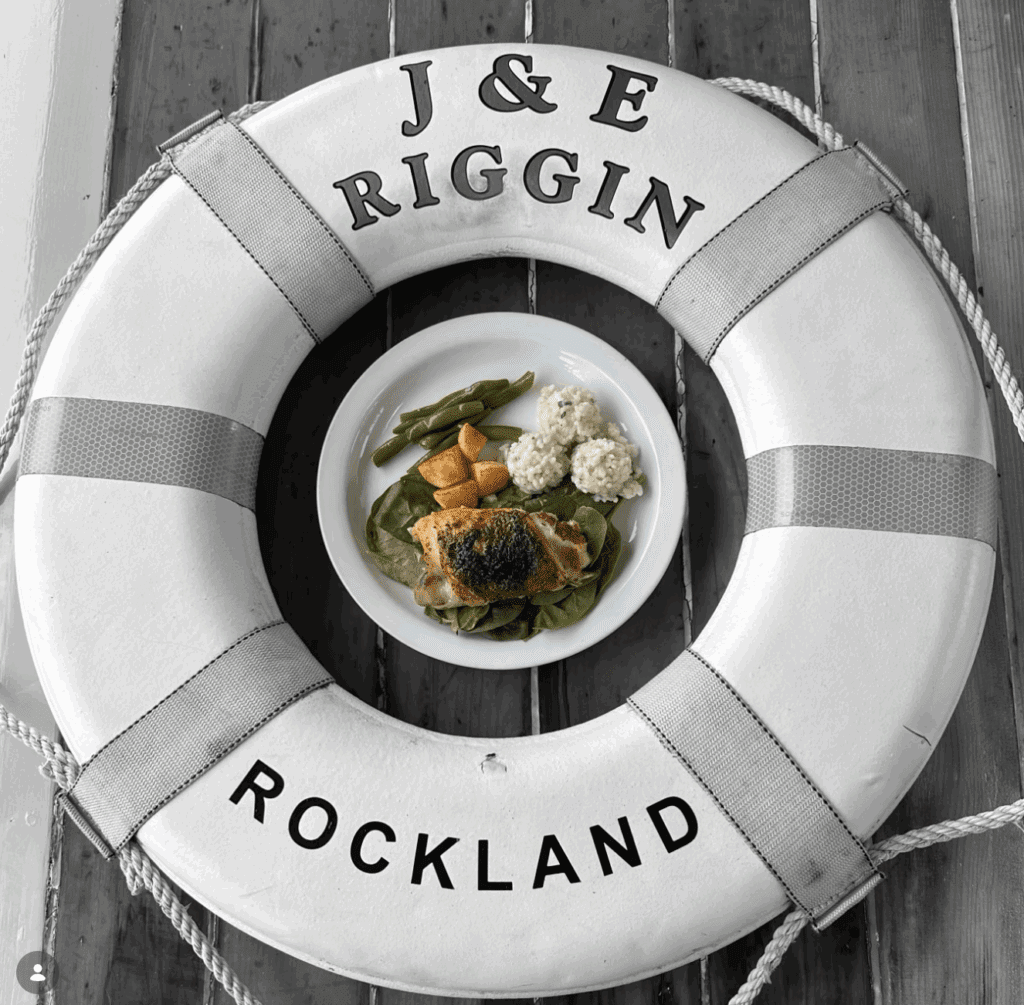
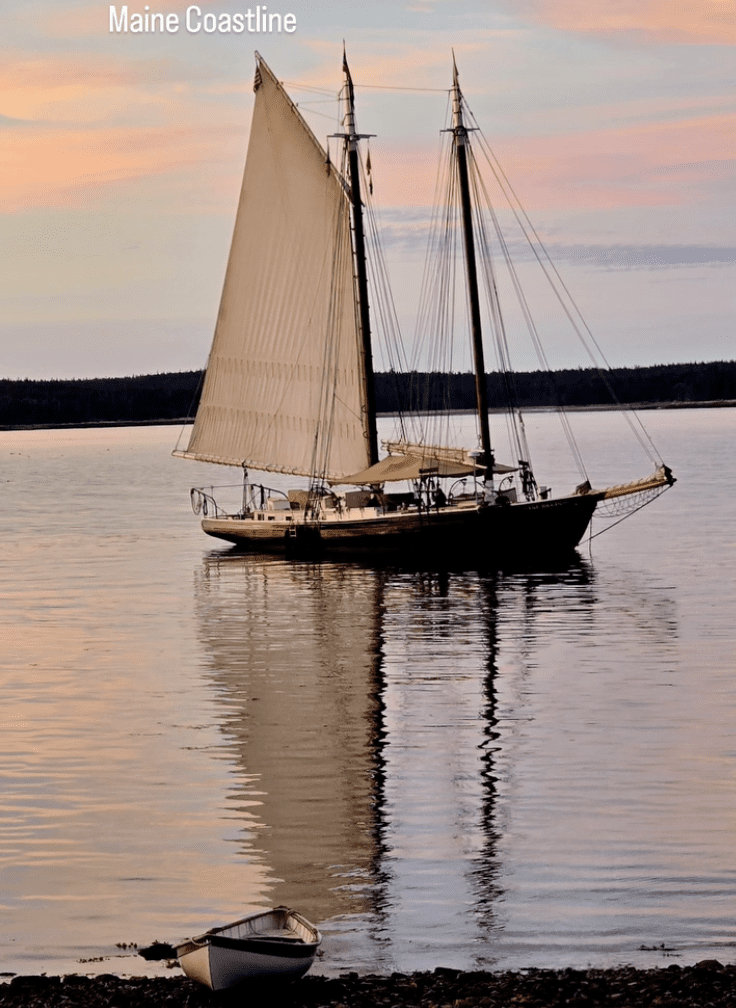
In this episode we chat with Jocelyn and Justin, the owners and captains of the historic Schooner J & E Riggin, for an inside look at life and travel aboard a nearly 100-year-old windjammer. We talk about what makes sailing the Maine coast so special, from wind-powered routes and themed sailings to cozy onboard life and fresh, locally sourced meals cooked on a classic wooden stove. We also dive into what guests can expect on a multi-night sailing, including fall foliage cruises, and why this one-of-a-kind adventure is unlike any other way to experience Maine.
View the 2026 sailing schedule for the Schooner J & E Riggin. Travel Squad Podcast will be sailing on the September 30 to October 4 fall foliage cruise – join us!
Find a great flight deal into Maine by signing up for Thrifty Traveler Premium and get flight deals sent straight to your inbox. Use our promo code TSP to get $20 off your first year subscription.
Explore more of our guest interviews and reach out if you have a cool travel story to share!
Contains affiliate links, thanks for supporting Travel Squad Podcast!
Schooner J & E Riggin with the Boat Captains – Episode Transcript
0:35
Welcome to this week’s episode of the Travel Squad Podcast. Today we’re joined by two very special guests, Jocelyn and Justin, the owners of the Schooner J&E Riggin, a historic windjammer offering three to six night sailings along the coast of Maine.
0:58
In this episode we talked with Jocelyn and Justin all about what makes an outing on the Riggan so special. From the uniqueness of being on a nearly 100 year old all wooden ceiling sailboat themed sailing excursions with two be determined destinations based on the wind since that’s obviously the only way to get around and enjoying freshly prepared meals from locally sourced main farms, all prepared on a classic wooden stove, this truly is a one-of-a-kind adventure on a historic vessel.
1:27
The passion for sailing is palpable in this episode. You’ll hear directly from Jocelyn and Justin about how and why they fell in love with sailing and each other and how they share that love with each and every guest that joins them for a sailing trip. We are so excited to introduce you to our guests.
1:45
Jocelyn and Justin, welcome to the show!
You 2 are a married couple together running the schooner J&E Riggan.
And today we’re going to get into all the sailings you run, the history of all that.
But for every one of our guest interviews, we like to go way back and we typically ask what made you fall in love with travel?
2:01
But since this is a sailing themed episode, we want to know what originally ignited your love for travel and your love for sailing and how you got to start this company together.
Thanks for having us.
Yeah, thank you.
So I grew up sailing on the South Shore of Long Island, New York as a kid.
2:19
Fell in love with it instantly and been doing it all my childhood but it wasn’t until I was about I believe I was 13 when my parents decided hey let’s go to Maine and go sailing on this almost 100 year old traditionally rigged schooner sailing vessel.
2:37
And I was like, wait, what?
Because I had grown up, you know, doing like small boat racing and, you know, fiberglass cruising boats with my folks along the great South Bay there.
So yeah, we piled in the car and went up to Maine.
And as soon as we got there, I was just like, Oh my God, what is this?
2:55
This huge boat with all the the lines and the rigging and had way more strings to pull than anything that I had ever sailed on up into that point.
And everything was so big and grand.
And for me being like this little 13 old kid stepping on board this boat, it was this awesome blast from the past.
3:13
And then we got out on the water.
The cruising grounds were absolutely beautiful.
The crew were like these like larger than life Rockstar figures to me being a small little child.
And from that point on, I was just absolutely hooked.
I was following the crew around daily, getting up as the sun rose with them.
3:33
And from that point on I was instantly hooked.
After that first trip, I would come up for about a month or so each summer after that trip to be an apprentice, like an intern until I was of the legal age to be paid.
3:49
And then after that I started working on the rig in here as a deckhand for multiple seasons until working my way up to the mate on board a more managerial role.
And then after that, I worked on a few other schooners and meeting my wife Jocelyn here.
4:06
And then eventually we made our way back to the mid coast after working on high end yachts to take over this business of at least where it all started for me.
But your journey was a little different.
Do you want to talk about your journey?
Huh?
Yeah, I didn’t start sailing until college.
4:22
Friend of mine talked me into going on a study abroad on a boat that was operating down in the Caribbean.
A professor of ours that we both really liked was going to be running a trip where we would spend 3 weeks island hopping in the Caribbean, sailing trade routes and studying the history of the islands.
4:39
But the caveat was we had to sail this ship, We were the crew.
So in between classes and lessons we were also sailing the boat from place to place.
And I had a really similar impression of this crew as being like these incredible, like strong young people.
4:56
And I had a fantastic mate who I thought was just just such an amazing woman.
And I was dying to be a part of the staff.
So the very next summer I worked on the boat that I had sailed on as a crew member.
It was called the Harvey Gammage.
5:12
And then actually that fall I took a leave of absence and I stayed on and taught on a semester trip S for high school students.
We started in Maine and we sailed all the way down to the Caribbean with this same group of high school students.
And they took their classes on board.
And I think at that time I was just absolutely hooked.
5:31
It’s like a bug.
Like you just kind of like get this sailing bug and you can’t get off these boats.
They just grab people, I think that way.
And so after working on that boat for a couple of seasons, I found myself in Maine.
I had learned about these historic ships up here and I started working in the fleet and within a week of of beginning my job on a three masted schooner in Maine called the Victory Chimes, I met Justin.
5:55
We worked on the same dock on two different boats in the same capacity and we met that way and we just really loved the community around these boats and couldn’t imagine ourselves anywhere else anymore.
So after we got married, we felt really certain that where we could see ourselves being happy for the rest of our lives was right on the boat on which we met on the dock that we met on carrying on the traditions that we had been taught by the people who taught us how to sail right here in Maine.
6:27
Yeah.
I love it.
That’s such a great back story.
And you know, being that Kim, Brittany and myself are West Coast people, not to say that people aren’t sailors out here, but when we go to the East Coast, I really feel that sailing spirit.
Like you just see it.
6:42
It’s almost like a lifestyle and you guys embraced it.
I’m thinking about earlier this year, we just went to Providence, RI in the airport, in the lobby, there’s a schooner and a ship out there with sails and everything, just like kind of like on display to the history of sailing, particularly Rhode Island, right?
6:58
And I know you guys are in Maine, but it’s just such an East Coast thing.
And here we are talking to East Coast people.
And now it’s your lifestyle and business for that matter, you know, and a love story intertwined with it.
It’s become quite an iconic thing in Maine, these windjammers.
7:14
I mean, the victory chimes, the boat that I started sailing on up here specifically is on the back of the main state quarter.
There’s just something about a schooner with a backdrop of pine trees and islands behind it that just.
Quintessential main it’s.
So good on the ice.
And so how long have you guys been running the Reagan now?
7:34
We just finished our fifth season.
We took over stewardship of the Reagan from the previous owners right on the heels of the pandemic.
And our first season running the business was in 2021 and we couldn’t start when we usually start.
We usually start Memorial Day weekend, but we weren’t able to figure out a way to get everybody on board again and like meet the guidelines until June of that year.
7:58
So a little bit of a late start, but still a fantastic first season on the water.
And then, yeah, we’ve been happily cruising all summer, from Memorial Day until the middle of October every year since.
Yeah.
So you mentioned how you guys are cruising every day from that time frame every year, but why don’t you tell the listeners what you do?
8:18
Obviously, yes, you’re sailing, but tell about the experience and what you do and how you host people, the different types of tours, things like that that you guys do and the experience on board.
Sure.
So I think the cruises that we offer are really a reflection of Justin’s and my interests and the things that we enjoy doing in the summer in Maine.
8:38
I think it would be difficult and inauthentic to try to incorporate things that we wouldn’t be doing ourselves anyway.
So we have fiber art trips.
I learned to knit on tall ships and there is an incredible fiber art community here in Maine.
8:57
And so we we offer knitting and crocheting and different like fiber related themed cruises.
I also am a big fan of craft breweries and craft cocktails.
So we have some programs where we sail from island to island visiting craft breweries along the coast and out on the islands, or where we offer drink pairings with dinners along the way.
9:23
Those were some of my picks for cruises that I thought would be a blast.
Still using ingredients from local main distilleries.
And yeah, I mean, I like what you said about, you know, being authentic.
I mean, that’s kind of like our whole MO with the boat and wind jamming is like to give you the most authentic experience and most authentic picture of what the coast of Maine is from the islands to the people to food, the beverage, everything.
9:55
We’re just trying to, yeah, give you this incredible authentic experience.
Yeah, To be honest, Kim and I had a really hard time as we were looking through the sailings that you guys have for 2026, what we would pick, like which sailing we would pick to go on because there were so many that interested in US.
10:11
I gravitated to the lighthouse and lobsters, but Kim’s not a lobster fan.
We looked at like the sales and sippings and cocktails one, and we’re also interested in the one where you do like stargazing.
So there were so many that you guys offer that we were like, wow, this looks really interesting.
10:28
Yeah, I think that the lighthouses and lobsters cruises was something that had been offered under the previous owners.
And just because when they were trying to come up with like, what the most, like, iconic main adventure would be, it would be sailing Penobscot Bay on this historic ship and visiting these lighthouses, which dot the coast of Maine, and seeing them the way that they’re meant to be seen, which is from the water.
10:54
And then, of course, Maine lobster is synonymous with any Maine experience.
So eating lobster and visiting lighthouses, like what a more perfect Maine experience than those things.
And to do it from the boat is just all the better.
And I think that the other major produced theme that Justin and I are like huge fans of is we do several music cruises season where we get local musicians and artists to come out and join us local, if not to Maine, then local to New England.
11:25
We have one that we do with a band.
They’re mostly in the Belfast area, but they’re a family band that play like folk and and work songs on board.
And then we do another one where we sail with Jeff Kauffman, who is a shanty man from Mystic, Connecticut.
11:45
And those trips are so much fun.
It makes the the hauling of sails and the lifting of the anchor so much easier when there’s a tune to do that work too.
Yeah, it’s one thing to sing a sea shanty.
It’s another thing to actually use the sea shanty for the purpose of a sea shanty.
12:04
I don’t know.
It’s just, it’s cool.
Yeah.
But as far as the experience of being on board from day-to-day, we get up in the morning each morning and have a breakfast that I’ve prepared on the wood stove in the galley and coffee from a local roaster.
12:20
And that fuels setting the sails and cranking the anchor for the morning so we can set sail and get out and explore the Bay.
And we anchor in any number of places.
We often sail throughout most of the day.
We’ll eat our lunch underway as we’re sailing by little islands, and then in the evening we find a place to anchor up before dinner.
12:43
Sometimes we take a walk ashore if there’s a nice coastal town to visit.
Or there are many islands we could pay a visit to that maybe aren’t inhabited but are just like a beautiful nature preserve to take a walk.
And then we enjoy dinner at anchor on board again, cooked on that wood stove.
13:02
And then we’ll like hunker down for the evening, play board games, sit and chat.
Often that’s the time if there’s some kind of a theme to the cruise where that comes into play.
And yeah, it’s just kind of like a lovely way to get to know people in a really simple environment where there’s like not a lot of.
13:20
There’s not a lot of outside distractions.
I mean, overall it sounds like a really unique experience and I like how you keep or you said twice, you know, the wood stove because I really want to give our listeners a picture here, right?
I mean, we’re talking about schooners and classic sailing ships, etcetera.
13:36
But this is an old ship that you guys have nearing 100 years old.
I think it originally started sailing in like 1927.
So we are very, very close to it being 100 years old.
So the experiences of the different types of tours that you’re talking about all are great, but I think the experience is being on board such a classic wooden ship that is only powered by sailing.
13:59
You Jocelyn cooking and making breakfast and then you, Justin doing the sailing.
Not that to say that you guys aren’t tag team and of course there aren’t other deck hands, of course, but it’s really the experience of being in these cabins that you guys have and just embracing that type of classic sailing experience.
14:17
Yeah.
And we’re counting on that.
Like we often encourage the guests to get involved in the operations day-to-day on board.
So we’re asking folks to help help get those sales up.
We’re asking folks to help us get that anchor up.
We’re asking folks to come down to the galley and help prep meal time ingredients and participate in making the day’s bread or prepping ingredients for the meals we’re going to eat that trip.
14:42
Like, I think that part of the experience and part of enjoying being on board is immersing yourself in that environment a little bit.
I suppose for some it could be like a kickback and enjoy a glass of rose while everybody around you is doing things, but I find that most people want to have that immersion.
15:01
They want to have the experience of being involved in the daily operations on board.
And it’s, it speaks to what you said in the beginning about how you fell in love with this lifestyle.
You were helping to sail as you were studying on board.
And you yourself, Justin, growing up learning how to sail and sailing different types of boats.
15:18
And that is the magic that caused you to fall in love, to get you to where you’re at right now.
So you’re almost sharing that passion and love with your guests.
That’s really beautiful.
I can’t wait to fall in love on the ship.
We really love the adventure of it all.
15:34
If we were running the same route, going to the same places all the time, I think that the experience would get stale for us too.
But no two trips are the same.
No2 menus are exactly the same, so and no two cruises do we go to the same destination.
15:50
Because we’re a wind driven vessel.
The wind and weather has a bearing on where we are and aren’t able to make the boat go.
So each day we get up and we look at the conditions and we decide where that day’s adventure is going to take us.
And it makes the experience like truly an adventure, even for us, which I think keeps it all fresh and fun even five years in.
16:14
Yeah, we’re not.
It’s doing the, you know, the scripted bus route.
It’s truly is, Yeah, Wherever the wind and tide take us.
We depart out of Rockland and we have to be back in Rockland at the end, but other than that, it’s sort of anywhere we end up.
I bet that makes for some interesting situations.
16:31
Has anything ever happened that blew you in the wrong direction?
Not too far that we couldn’t get back in time.
A little bit of drama, but nothing too crazy.
Drama, I mean, but again, that’s kind of the fun of it maybe that, you know, that wind didn’t blow us in the direction that we necessarily wanted to go, but it took us in this different direction that we necessarily wouldn’t go.
16:55
So we found a new place.
I mean, I’ve been up here sailing this coast for almost 20 years and I’m still going to new places.
I still have not seen all of what this Penobscot Bay has to throw at us.
17:11
Like how many new anchorages do you think you went to even this in like this are telling me 5.
New 5 new places just this year, like I’m always like sailing by a place like oh, that would be really cool to tuck into.
Let me take a look at the chart.
Some evenings I just stood awake in my bunk just like flicking through, you know, Google Earth looking at little cool places or like, oh man, that’s an island that’s uninhabited that isn’t privately owned.
17:37
We can go on that island and walk around, maybe cook some lobsters or just go on a really nice hike.
So like, yeah, I don’t know.
There’s so much freedom out there when you’re out on the water just sailing around this beautiful spruce cladded, rocky coastline that, I mean, anywhere you go, it’s just absolutely beautiful.
18:00
It’s a postcard.
You’re living in a postcard out there.
It’s incredible.
So we’ve discovered, obviously I guess where you go is dictated by the wind.
We know this.
We talked about how you have specific themes, right?
Like one of them is a star gazing, a new moon, of course, The Maine lobster, fall foliage, etcetera, right?
18:19
So the theme will always stay depending on which theme you sail on.
But of course where you go will be different.
But nevertheless, how long are your guys’s sailings?
Do you have multiple days, like 3-4, five?
Are they all five?
Are they all shorter?
18:35
Tell us a little bit about that.
We do a mixture, so we do a mixture of three, 4-5 and six day trips and there’s no kind of set rhythm as to like how they’re dispersed through the schedule.
18:50
It really depends on what the theme is, instructor availability, and also we kind of work the schedule around events that we participate in, whether it be, you know, like gathering of tall ships or like a music festival or something.
19:06
That kind of is what it dictates where the trips are and where the length of trips are.
But yeah, and where from three to six day.
And I think that you raise a good point.
It’s an opportunity to clarify the name.
So there are a lot of things that these ships up here get called.
You might hear it referred to as the schooner J&E Riggan.
19:23
The schooner refers to the boat itself.
A schooner by definition is a ship that the main mast is taller than the four mast in front of it.
And so we often call it a schooner, but you might also here referred to as a windjammer, which refers to the job that the boat does.
19:43
Windjammer used to be a derogatory term for sailing boats, but it’s sort of been adopted by sailing ships that take paying passengers out for multi day cruises to distinguish it from boats that maybe take people out as trainees or to distinguish it from boats that just take people out for like an hour or two.
20:03
So all of our cruises are multi day.
When you book a spot on a trip, you’re booking a bunk.
If you come with a friend, you might, you know, you might book your bunk and they might book theirs and then you’d end up in one cabin together.
It’s not uncommon for people to come by themselves and share a cabin with a stranger.
20:20
It’s a great way to make a friend.
And and then I would say that having people out for multiple days, to me, having worked on a couple of boats where we only go out for the day, having people out for multiple days seems like the sweet spot for me just because I actually get to know people over the course of before days.
20:37
You build like a closeness with your shipmates.
You actually have time to, like, connect and really get to know people.
It’s hard to do that in just a couple of hours.
Yeah.
What?
You feel like is like one of the most beautiful things about what we do and what these ships do is, you know, in the beginning of the week, we’re taking out 24 complete strangers from all different walks of life from all different parts of the country, sometimes the globe and watching the bonds form, the friendships develop.
21:07
And then, you know, 4-5 or six days later, watching them all leave hugging.
Some of them are in are in tears because they just made a lifelong friend.
And it like, I don’t know, being on board these boats, it brings you back to a much simpler time in history.
21:26
And one of my favorite things about is it really brings you back to like what’s truly important in this world as far as community, good food, nature.
And it just, I don’t know, it’s, it’s just a beautiful thing to, to watch and be able to facilitate it.
21:45
That’s our job.
We facilitate travel, but we’re also facilitating these these connections and these friendships.
It’s really special.
And the environment is so well set up to be present with the people and the experiences that are right in front of you.
For anyone that might be wondering, is there cell phone service on the boat or is there no cell phone service and that adds to the ability to be present?
22:08
Cell phone service on the Bay, it’s pretty hit or miss.
I’ve had some guests who say they had much better cell phone service than they expected.
They thought they were never going to be able to like get a text the whole time.
But you could get a text out here and there.
You probably couldn’t have like a meaningful phone call or like a long FaceTime.
22:25
But yeah, I think for the most part, I think being able to unplug is something that is more of an asset to people who are seeking this kind of an experience than it is like a bummer.
Most people are are pleased to unplug in an environment like this and I think most people who are seeking an experience like this might be looking to unplug a little.
22:47
I can tell you we went on a backpacking trip.
It was last year, actually, now that I think about, it’s been a long time now, but Brittany and I went on a backpacking trip in the Grand Canyon and there was no cell phone service.
So for four days we did this big backpacking trip, camped, and it was exactly like you’re describing it.
23:05
You’re in nature, you’re connecting with the people around you and eating with them and hiking with them and getting through these ups and downs.
I left that trip feeling better than I’ve ever felt in my life.
It sounds kind of like it’s kind of liberating, right?
It’s like we get people.
23:20
It’s like we’re coming in on the last day and they’re realizing like, Oh, my goodness, I just spent five days on a boat and I did not touch my work e-mail, my voicemail.
Like, how, how do I go back?
How do I?
Yeah, I had to talk to somebody in person.
23:39
And it was so refreshing.
Well, I love that.
I love that it’s all about community and an experience.
And one thing that we always talk about too, is we talked about the bunks and you get to meet people in the bunks, but what’s the bathroom situation on board?
23:54
We have two heads on board.
Head is just fancy sailor talk from Marine bathroom.
They are super simple to operate.
They’re not intimidating.
It’s funny.
People are coming up are like, Oh my God, how do I use the bathroom?
It’s like, do it like what you would at home and then you just press this button and machinery takes care of the rest.
24:13
You don’t have to dump water in it or you.
Don’t have to like, you know, it’s the in as far as we sail the boat like they would have 100 years ago, but we don’t go to the bathroom like.
They would OK.
Some modern amenity.
Like navigation equipment is modern, safety equipment is modern.
24:33
The sailing it’s from 100 years ago.
And so there’s two bathrooms and all 24 people on board are using those same 2 bathrooms.
Yeah.
And they’re up on the deck.
So the are below the deck level and then the heads are up on deck, up on deck and.
24:49
Two works out really well, like.
I’ve not ever had to wait.
No, never had to wait.
One of the bathrooms also converts into freshwater shower, so after you go swimming or after you have eaten your 5th lobster on a deserted island, you can take a shower.
25:10
Like we’re not Barbarians out there.
One thing I was worried about was the possibility of getting seasick.
How likely is it that someone would get seasick on a sailing?
Honestly, we don’t run into that problem often for a multitude of reasons.
25:28
The Reagan, she’s almost 100 feet long, just about almost 30 feet wide, and she weighs over 60 tons.
She’s a pretty stable platform.
And also we’re not in it for the terror.
Like, we’re not going 1520 miles offshore trying to, you know, get the world’s largest tuna.
25:49
We’re in shore bobbing and weaving through the islands, through the protected waters.
And I mean, that’s where all the postcard scenery is, you know, So like, again, we’re not in it for the terror.
I’m not trying to take you out there in, you know, 5 to 10 foot seas to like, you know, recreate a scene from Captains Courageous.
26:09
You’re on vacation.
I’m trying to keep you comfortable.
Well, that’s good because Britney is usually prone to seasickness, although she does use the bands and for the most part that really helps.
But that is good to know because obviously, you know, you guys are not a cruise ship, right?
I mean, we’re highlighting that’s fact.
26:25
And of course that is the highlight that you aren’t actually a cruise ship, but a cruise ship is big, sturdy, and still people get sick on it.
So that’s good to know that even with that, if somebody’s prone to that, that shouldn’t really be an issue.
But I want to kind of back up just real quick because we were talking about the bathrooms and you said to and that hasn’t really created an issue.
26:43
And I believe it.
If you think about it like on an airplane, a normal airplane, how many people?
And sometimes there’s only 2-3 baths.
Like you go like a temple restaurant.
I mean 40-50 people in it and.
Of course.
But where my mind goes though is like if someone’s thinking, oh, like when I got to brush my teeth in the morning, everyone’s trying to do that at the same time.
27:04
But you guys have sinks with potable water in each cabin.
Is that not correct?
So I want to kind of like highlight that you have the amenities of being able to kind of do your routine in the cabin, but then just of course the bathroom is one thing of having to to go, but otherwise you have all that type of comfort in there too.
27:22
That’s absolutely right.
And I keep hot water going on my stove all day.
There are pitchers in all of the cabins, like these big red tin enamel pitchers and all of the cabins.
So it’s not uncommon for somebody to bring that tin enamel pitcher down to the galley in the morning and say, you know, I’d like some hot water so I can freshen up, wash my face, shave, whatever, You know, So that’s not something that’s preventing people from being able to go into the bathrooms during that time.
27:46
All of those things can be taken care of in the cabin.
And I would say for about, like, maybe half of the people who come sailing with us, take a shower on board.
And there are also a whole contingent of people who bring, like, wipes and treat it like a backpacking trip and, like, just like, clean up in the cabin or like, yeah, kind of just, like, treat it like a camping trip kind of a thing.
28:08
Yeah.
OK, rough it out there.
Yeah.
Yeah, yeah.
Right some.
Some might call it glamping.
Whatever floats your boat.
We like glamping over here, so we’ve got the bathrooms down.
And on this podcast we need to tell the squaddies about the bathroom.
So I feel like we checked that box and I’m confident in the bathroom now.
28:26
But the boat, I want to talk more about the boat because you’ve painted a picture, 100 foot long, 100 years old.
But what does that look like?
Like, is it all wood inside?
Does it look rustic?
If someone hasn’t seen it and they’re walking in like, what would they see?
28:41
Yeah.
So when you first come from the parking lot, as you’re walking toward the boats, the first thing you’re going to see from the parking lot is the very top of the masts with like, the big flags flying.
We fly a main state flag and a big Pennant that has the Riggins name on it.
28:58
So before you see anything, you’re going to see the top of those masts.
And then as you get to the top of the ramp down to the boat, you’ll be able to see her in all of her glory.
She’s a huge wooden ship, just one deck, so not like the multiple layers of decks down and down and down.
29:15
There’s not like 3 stories tall.
She’s, you know, a normal height, you know, probably at her highest point stands about 10 feet off the water, painted sleek gloss black with, you know, the big varnish bow spread off the front.
29:30
Just like standing there just looking as gorgeous as ever.
Or or at least I think she looks as gorgeous than ever.
And my totally unbiased opinion, you walk down the dock and you’re instantly taken back to the 20s of like tailing off on the golden age of sail.
29:49
But the Reagan specifically, so she was originally designed for oyster dredging and the Delaware Bay.
So she was designed to be a fast working boat.
So she’s not super high sided because all the gear that was in the water, they didn’t want to have to pick it up 10 feet and you know, over a rail.
30:07
They wanted her to be fairly low to the water and.
So that they could pull Nets full of oysters onto the boat easily.
And just sleek looking.
So she looks sporty for her age, and I think that’s part of what makes sailing her just so much fun.
30:25
It’s just like you’re right next to the water.
There’s this certain connection that you get as you like sailing along with over 4000 square feet of sail area above you, just driving the 62 tons through the water, rushing right by you.
30:40
There’s just this exhilarating feeling it gives you.
So like, what can you say about the look of her that doesn’t have to do with like the feeling, the feeling of her?
Yeah, she’s all, all wood.
Like I said, her hull is black.
She has bright work or varnish on her as well, highlighting the fact that she is made of, you know, these gorgeous pieces of wood, that she’s just a a living, breathing model of craftsmanship.
31:05
So you almost feel like you’re in a cabin, Like a wood cabin but boat style inside.
Yeah.
I would say that down in the cabins, it has sort of like a log cabin E feel.
There are some areas that are painted white, but most of the cabins are varnished wood.
31:21
I love history and ruins.
We talked about that a lot on the podcast.
Just old places that still exist, and although 100 years isn’t old too much in the grand scheme of certain types of ruins, for 100 year old boat, it feels like you’re walking back in time, at least with the picture you’re painting.
31:41
Yeah, I think that that’s true.
There’s a lot about the boat that would have looked different in 1927.
She wouldn’t have had a cozy galley with like cushioned benches to sit on to enjoy your meals down below.
She wouldn’t have had cozy beds with duvets on them.
31:58
She wouldn’t have had sinks in every cabin, probably would not have had such nice heads either.
All of those things were added in the 70s.
So back when she was fishing, it would have been a pretty big empty space down below where they would have kept the oysters that they were pulling up and there would have been oysters piled around the deck as well.
32:18
Those things are not so much the case now, but I think in the 70s when she was converted into the passenger trade, when she was converted into the wind jammer that we see now, I think they wanted to preserve like an older feel, hence the installing of the wood stove rather than introducing, you know, alcohol stoves or something like that instead.
32:40
And I think that there’s something to that.
There’s a certain coziness that those kinds of things bring that kind of keeps that authentic historic feeling.
I love that.
You mentioned the wood stove.
When I think of wood stove, I think of like wood fired pizzas.
But tell tell us and our listeners about what kind of meals they would typically have or help make on the ship on a trip.
33:03
Yeah.
So my food philosophy on board has a lot to do with sourcing things that are local and in season.
We have a fantastic farm share and a lot of great relationships with local farms.
We have a fantastic local butcher.
I have a seafood market really nearby who has a great line on who’s catching things nearby that are delicious.
33:26
So at the beginning of the trip, I run out and I visit all of those places and I find out what’s in season and what looks great.
And those are the things that become the foundation of our menu for the cruise.
Some things we can count on, some New England classics you’re likely to see, you know, a New England clam chowder or a lobster bisque or something of that nature at some point on board.
33:49
But also I like to hide, highlight our fantastic local produce, just because there are so many farms where we’re situated in the coast.
We get kind of the best of both land and sea.
There’s fantastic seafood coming out of the Bay over which we sail.
34:06
There’s fantastic seafood being farmed on the waters over which we sail.
And then just a few miles inland are some amazing farms that are growing some incredible organic produce and a lot of fantastic farms that are raising happy animals that make delicious proteins as well.
34:24
So as much as I can keep things that are in season the better.
And similar to Justin’s vision of keeping the adventure fresh for everybody by having these itineraries that are like sort of day of and varying up the destinations to which we travel based on what the weather is doing.
34:42
I similarly am varying up my menu all the time because if we were eating the same things every trip, we would get bored also.
So never twice the same.
I’m always impressed by people who can pull random ingredients together and make delicious meals out of it.
34:58
Have you always been a good cook or was this something that came about with the ship?
Honestly I don’t enjoy cooking as much at home really as I do.
I think the wood stove is kind of like this magical factor that really made me love cooking and food.
35:15
Didn’t grow up loving cooking or anything like that.
This is like a relatively or a fairly new discovery, but our first few seasons that we had the boat, I didn’t cook on board.
We had hired chefs and as I was learning about the wood stove, I was really enjoying it.
35:31
And Justin was really enjoying me having on the boat with him instead of in the office receiving reservations and taking the calls and responding to emails.
So we kind of shuffled my role into the galley.
I think that was year three that that started and I have kind of loved it ever since.
35:49
It’s been really fun to get to be on board and the wood stove I think just does something kind of magical to like baked goods especially.
I love baking on board.
So there’s a lot of homemade breads and a lot of like little pastries and things like that because the baking is just so much fun.
36:07
It is also this dynamic thing.
While the boat is this dynamic environment, the stove is also this dynamic thing.
Yeah, everything you’ve described cooking wise and what you serve on board sounds amazing.
But I was also wondering, do you have the ability to accommodate food restrictions and allergies?
36:25
Yeah, that’s a fantastic question.
So I do.
It’s not unusual for us to have folks who come sailing with us that are gluten intolerant, dairy intolerant, that have a variety of different allergies or special diets that they adhere to.
And I have yet to meet a diet that has caused me to say, I’m not sure that I can accommodate you.
36:46
Almost always we can find a way and well, the galley is really small.
I can never guarantee like a completely allergen free environment, right.
So like if you have a really, really severe gluten intolerance where like my galley has had flour in it before and I have wooden counters, but I’ve certainly had people on board with celiac where we’ve just kept gluten out of the galley for that cruise and it’s been OK.
37:10
Yeah, we haven’t had any and everybody’s been fine.
We haven’t had any.
Yeah, yeah.
I just, I don’t know.
Yeah, I always call and check in with folks who you have dietaries too.
So if you make your reservation online and you put something in the notes field about a severe allergy, often I’ll follow up with a phone call just to make sure that I understand exactly what your needs are.
37:29
That’s great.
And you talked about the galley.
Is that where the passengers are going to eat, or do you eat on deck, or what’s that situation looking like?
Yeah, no, that’s a great question too.
I would say for the most part, as long as the weather is kind to us, folks eat on deck.
That’s where all the beautiful scenery is.
37:45
And there’s a lot going on up there In inclement weather or if it’s chilly, the galley is a great place to hang out.
The wood stove keeps that space cozy, and so it’s a nice place to tuck in and warm up.
If you’re considering a fall foliage trip, you may find that you want to tuck down into the galley and warm up sometimes, and huddling in by the wood stove is a great way to do that.
38:04
But yeah, the deck is a common space where everybody is welcome to hang out.
And the only place below deck that isn’t cabins is the galley and salon.
So a small section of that is my prep area and the wood stove, but beyond where I’m cooking, there’s a space where there are cushioned cities and tables.
38:25
So you can eat off your lap up on deck and take in the scenery.
But if you’d rather eat off of a table, you can come down to the salon and eat down there.
We also keep things like board games and reference materials because it’s not unusual for folks to come out on the Bay and see a bird and be like, what was that bird?
38:41
I’m like, oh, I have a book about that, You can check that out.
The salon is just like a great common place to hang out and chat.
Also, there’s often food prep going on down there as well, so folks who are interested and prepping meals or participating and like making the meals on board often hang out down in that salon as well.
38:59
Well, I think you guys have painted a really perfect picture of the experience on the J&E rigging, right?
From the fact that it’s a near 100 year old ship, you don’t really know where you’re going to be going that day.
And I say that in a good way, right?
You’re really up to the gods of the wind, right?
39:15
And where you’re going to be going.
You know, your theme, the uniqueness of the food experience from the locally sourced, like farms, fruits, veggies, etcetera.
But as we’re wrapping up, why don’t you guys just tell us about a memory from a past trip that you guys took on board that was just a standout moment where you thought like, yes, this is exactly why we do what we do.
39:38
Yeah, so.
So it’s definitely hard to choose.
We have played host to some like really beautiful weddings.
We’ve been aboard and operating in years where people who crewed on the boat back in the 80s came sailing and we’re sharing stories of their experience on the boat, which mirror really nicely experiences that we had on the boat even more recently.
40:02
But one moment for me that was really special was a few years ago when we were sailing into Brooklyn, which is where the Wooden Boat building school and Wooden Boat magazine is published there.
And we were sailing in with a bunch of other historic ships that were also visiting the school that trip.
40:19
This would have been the wooden boat sail in cruise on our schedule and during that time another.
Historic Delaware oyster schooner was being refurbished and refit in a shipyard on the coast of Maine, and she had recently been launched.
40:37
And they decided to pay a visit to the school knowing that all these other historic ships were going to be there.
And so we had a moment where this Delaware Bay oyster schooner that was normally living in New Jersey was sailing with the Reagan.
40:53
And we were like sailing back and forth past each other.
And had this moment where it dawned on me that these two ships that may well have known each other almost 100 years ago on the Delaware Bay when they were both employed as oyster dredgers, we’re now like seeing each other for the first time maybe since then, like here in Maine.
41:14
And I was just like, so overwhelmed by what an incredible moment that would be.
And it’s hard because I think that in a lot of ways, Justin and I and many people who love the boat so much, like, personify her.
She really has, like, a personality.
41:30
And to imagine her seeing this other ship that she hadn’t seen in almost 100 years is like, such a cool moment for us.
Yeah.
And for them.
And so I think that in that moment, I just like, washed over me.
41:45
What an amazing thing it is to be able to be a part of keeping a piece of history like this around for more generations to see an experience.
What about you, Jesse?
I would say probably one of the more recent ones.
42:00
Again, it has to go back to another, another wooden boat sailing memory.
This past season for the wooden boat sailing, we as like the collective group of old historic ships up here, we decided instead of just, you know, sailing into Brooklyn, Maine and all sitting on our own individual anchors that we were going to raft up.
42:18
And what that looks like is we basically we, you know, one boat puts their anchor down and then we just all tie up together.
Like we dock next to each other, treating each boat as a dock and it keeps going and going and going.
So we have.
Yeah, like a big raft of boats all tethered together, so it and then you can move between the boats.
42:39
Yeah, we do that out here at in Lake Travis, out here in Austin.
Little bit of a different scenery than this, but.
Yeah, no picture that, but with like 900 year old sailing.
That’s very.
Cool, sorry. 9100 year old Yeah 900.
42:58
Year old sailing ships.
And then so like that’s an always incredible when we get to do that, it’s a grand spectacle.
But later that evening we had this group of musicians on board that were kind of going from boat to boat playing music.
And at the end of the night they ended up on the Riggan because one of the band members, one of the lead members used to be a a crew member on board.
43:18
So he the Riggan holds a a certain you know has a soft spot in his heart.
So he and they ended up the night playing on the quarter deck of the Reagan and we had all the other schooner captains were were gathered around and we started singing this song that we all knew the words to.
43:35
And it was just like so magical getting swept up in it and just like taking a second while we were singing and looking around and just like like 100 people are just gathered on the back of this boat.
It’s probably sitting a few inches lower in the water line with all these people.
43:51
And we’re all just singing this song in unison, just like one big incredibly happy family out on the water, just being a part of this incredible experience, experience and keeping these incredible boats alive and these incredible traditions going on this beautiful coastline.
44:11
And it’s that was like one of those moments where like, Oh my God, if I was not in front of 100 plus people, I would be bawling because this is just beautiful.
This is just beautiful and cool.
And Oh my God, I just got paid to do this.
44:30
I love both of your answers, like you can just feel the passion that there is behind the work that you do and how much you love what you do.
And I know it’s work, but I’m sure you’re glad to be doing something that you love every day.
Yeah, it doesn’t feel like it.
It’s not just a job like taking over one of these boats and operating them is, you know, it’s not just a job.
44:50
It truly is.
It’s a lifestyle choice.
No.
I want to quickly say too that you have your trips that are prescheduled.
Some are themed.
You also have certain weeks that are reserved for people who want to book private trips.
And you mentioned a wedding.
What other types of people have you hosted on private trips like family reunions?
45:10
Family reunions, birthdays, travel groups have come and done private charters as well.
Yeah, I would say the majority of folks who book private charters, often they’re groups.
So they have like a common interest.
45:26
I know we’ve had like rug hooking charters in the past, groups of like all women who just wanted to travel together and camp together.
So there are fiber groups, groups of like fiber artists who all come and charter the boat just to like hang out and do their craft together or to have some kind of an art retreat.
45:46
A Wellness charter this next this next season like this this woman who actually sailed with us this previous year as just a normal guest with her husband loved it so much was like, Oh my God, I run a day spa.
Can I like put a trip together with my clients and come out on board and like.
46:04
Do like a well do.
Yoga and like, facials and like hair and nail treatments and we’re like, heck yeah.
I love that.
We have not on the on the schedule really like if if you have a small group, it’s it’s kind of perfect.
And we’ve definitely hosted weddings and birthdays and big family gatherings, all of those those things.
46:24
I think.
Yeah.
And you can just reach out kind of build something custom with you.
Totally.
I think it’s helpful for us if you know approximately what you want to achieve, but we can help to build an itinerary based on, you know, where your interests are, if there are particular kinds of experiences you’re trying to curate on board.
46:45
We know the Bay at this point very well, and so within just about any time frame we can try to find a way to incorporate all of the things that you’re trying to experience while you’re aboard.
Yeah, we know the Bay, we know the, we know what the Bay has to offer.
47:01
We know what the boat can handle.
And I don’t know, I’d say we’re pretty good at curating a good time.
Yeah, it.
Sounds like you are, and we can’t wait to experience that.
And it sounds like you’re keeping things interesting too, Like every day is a little bit different, every meal is a little different, every trip is a little different.
47:19
Do you have anything exciting or new or experimental you might be rolling out for this upcoming season?
That’s a great question.
Yes, we do.
So we have a knitting instructor who comes with us in the spring.
She sells in June.
She owns a shop called Fiber and Vine in Norway, ME, and it is both a fiber store, but it she sells wine as well.
47:43
And when she was out sailing as a knitting instructor, she was like, you know, it’d be so fun as having wine pairings with some of these meals.
So next year we have a brand new cruise in August where she’s coming out on board and doing wine pairings with my meals.
And I’m so excited to work with her that I can’t believe that that rolled right out of my head just now.
48:02
But yeah, no, I’m very excited about having wine pairings on board.
We’ve never done wine.
We’ve always done cocktails or beer.
Yes, I think we did see that one as we were browsing through this season and those caught my eye.
The beer, the wine, the cocktails, all three of them was like any one of those.
48:20
I bet it’s going to be a good time.
Yeah.
Do you have to know how to knit before you come on board?
Or what level do you have to be?
I would say it’s not unusual for people to come on board who are just really interested in learning.
So there are people who’ve been knitting their whole lives and are just like trying to acquire new skill.
48:36
Or maybe they have like, I don’t know, a pattern that they’re struggling with and they just want some support.
But it’s also not unusual for us to have people come out who are just really interested in learning and are having a hard time getting started and they learn to knit on board, which is really fun.
I would also say that we have a fair amount of spouses, people who really enjoy those crafts, who are like, well, I’ll hang out on a boat for a few days while you do your project or whatever.
49:00
And that is also totally cool with us.
And I would say sometimes even they learn how to do the things and see how good a time everybody else is having with them.
They like, OK, I’m getting FOMO end up doing it too.
49:17
And also the instructors that we bring on board like, you know, are not Snooty about their craft.
They are there to to share their expertise and their knowledge and be, you know, super welcoming you.
Know yeah I’m really excited I’m excited to experience cabin life to see a historic boat have these amazing meals go explore some islands to see where the day takes us.
49:41
So Squatty’s if you haven’t caught on yet Kim and I are actually going to be doing a sailing trip with them and we plan to be going on their trip which is the fall foliage trip from September 30th through October 4th 2020 sixth.
So if you’re interested, come join us.
49:58
So squatty’s come hang out with me, Brittany, Jocelyn, Justin, everyone else on board.
We’re going to have a really good time.
We’re going to link all of the information in the show notes so you can easily find the information to this trip and all the trips that they have in 2026.
But before we sign off and thank you both for being here so much, is there anything else you want the listeners to know or to leave them with, or where to find you?
50:20
Yeah, So I mean, as far as getting in in touch with us and and seeing like what we’re doing, you can find us on Facebook, Instagram at Schooner Reagan.
We’re posting pretty regularly just about dailies with updates on what we’re offering, whether it be trips, ship store, what Jocelyn’s working on, like as far as recipe testing for next season, what I’m working on in the shop.
50:43
And if that interests you at all, as far as like the bow, you know, keeping a historic ship alive and well and what that process looks like.
You can also get information off of our website at schoonerreagan.com.
And I would say those three are probably the main avenues towards the boat and getting more information about us and and what we’re doing.
51:06
Fantastic, and we will link all of that again in the show notes, Squatty, so you can find all of that.
Thank you so much for coming on to the Travel Squad Podcast.
We’re so glad that we got to meet you and talk to you before we go for the experience.
We’ve got the connection built.
We’re going to deepen it out there on the water, yeah.
51:22
And yeah, thank you guys so much for for having us.
This was super fun.
I mean, it’s we always have a good time talking about the boat and what we do and and spreading the the good word of wind jamming.
Well, I know our listeners heard the passion.
And if that’s just a passion of like your hobby of what you like, I know that’s going to translate to the overall experience that you give everyone on board.
51:43
So I don’t know how anyone can’t see that.
So it’s going to be a fantastic time, that’s for sure.
Well, thank you.
Yeah.
Thank you, Squaddies, for tuning into this week’s episode.
Be sure to keep the adventures going with us on all the socials at Travel Squad Podcast.
Tag us on your adventures and send us in your questions of the Week.
51:59
If you found the information this episode would be useful, or if you thought we were just plain funny, please be sure to share with a friend that would enjoy it too.
Please subscribe, rate, and review our podcast and TuneIn every Travel Tuesday and Fridays for new episodes. Stay tuned for next week’s episode, we have some more amazing adventures and tips in store for you.






Comments
Comments Off on Sailing the Maine Coast: Aboard the Historic Schooner J & E Riggin with the Boat Captains