


4 Days in Kyrgyzstan: Touring Through Canyons Around Issyk-Kul Lake, Mountains, Meadows, Yurts & Eagle Hunting
We’re taking you off the beaten path to Kyrgyzstan, and sharing an unforgettable private 4-day tour around Issyk-Kul Lake! We cover the canyon hikes, horseback riding, an eagle hunting show, yurt camping, and hot springs that make this Central Asian gem worth the trip.
Take this trip exactly as we did:
- Stay at the Sheraton Bishkek before and after your tour. We also liked Ak Keme Hotel and Orion Hotel Bishkek
- Book a Private Airport Transfe
- Check out the exact 4-Day Issyk-Kul & Chon-Kemin Private Tour we booked, and explore other Kyrgyzstan experiences in our curated Viator shop.
Make sure to listen to our full episode on Bishkek too! And if you love off-the-beaten-path adventures as much as we do, check out our Georgia (Tbilisi, Mtskheta & Kazbeggi) episode too!
Kyrgyzstan is a country in Central Asia defined by rugged mountains, turquoise alpine lakes, sweeping valleys, and living nomadic traditions. More than 90% of the country is mountainous, with the Tian Shan mountains providing a dramatic backdrop almost everywhere you go. It’s a paradise for hiking, horseback riding, and camping, and it offers a real glimpse into nomadic culture — yurts, eagle hunting, and centuries-old customs that are still part of everyday life. Kyrgyzstan was also once part of the Soviet Union, so while the country has its own indigenous Kyrgyz language, Russian is spoken everywhere and signage is in Russian.
We love hiking and outdoor adventure, so this trip was made for us. We flew into the capital, Bishkek, spent a day there, then set off on this 4-day adventure around Issyk-Kul Lake. It’s also a destination that’s just starting to go viral — so if off-the-beaten-path travel is your thing, now’s the time to go.







Getting to Kyrgyzstan
We flew into Bishkek’s Manas International Airport on Turkish Airlines out of LAX, with a layover in Istanbul. A few tips before you go:
- Best time to visit: Summer, for hiking, camping, horseback riding, and swimming in the lake.
- Get an e-SIM or data plan for navigation, translation apps, and Yandex Go (the local rideshare app).
- Download WhatsApp — it’s how locals communicate with restaurants, tour operators, and services.
- Download offline maps if you plan to explore independently.
- Bring cash. Kyrgyz som is the local currency, and while cards work at hotels and larger businesses, cash is essential for markets, small restaurants, and toilets. The small arrival terminal at the airport didn’t have a reliable ATM (it was under construction).
- Try the local food: kattama (fried flaky dough), borsok (plain fried dough), lagman (a noodle, meat, and vegetable dish), manty (dumplings), and samsa. Order a cup of traditional tea while you’re at it.
- Russian is primarily spoken in the cities, with Kyrgyz spoken more in the villages.
- Carry toilet paper and hand sanitizer — public restrooms aren’t always stocked.
- Pack layers. It’s hot in the valleys and cool in the mountains, and bring sun protection (hat, sunglasses, sunscreen).
We booked a 4-day private guided tour through a company called Datka. You can also self-drive if you rent a car — we saw plenty of people doing it themselves — but it comes with a lot more logistics.
Day 1: Burana Tower, Konorchek Canyons & Chon-Kemin
Our guide Azamat picked us up at 8am, and our first stop was Burana Tower, one of Kyrgyzstan’s most important historical landmarks. This 11th-century minaret is the last remnant of the ancient Silk Road city of Balasagun. The tower originally stood much taller before earthquakes and centuries of weathering reduced its height. We climbed the narrow staircase inside for views over the Chuy Valley, and explored the site’s ancient stone carvings, known as balbals, along with a small museum of Silk Road artifacts.
Afterward we stopped for tea and kattama — a traditional Kyrgyz flatbread made by layering dough with butter before cooking it until golden and crispy outside and soft and flaky inside, dipped in cream and served with tea in bowls instead of cups.
From there we hiked the Konorchek Canyons in the Boom Gorge, known for dramatic red and orange sandstone formations carved by wind and water over millions of years. The hike was 10.6 km (about 6 miles) and took just under 3 hours — we followed a dry creek bed, passed towering rock walls, used a rope four times to scramble up sections, and topped out at a panoramic viewpoint. It reminded us a lot of Utah.
We ended the day at our guesthouse in Chon-Kemin National Park, known for its mix of rugged mountains, alpine meadows, forests, rivers, and valleys. Dinner included a Chinese salad, soup, a chicken and rice dish, and unforgettable homemade raspberry jam.
Day 2: Horseback Riding, Eagle Hunting & Our First Yurt Stay
After breakfast at the guesthouse, we set off on a 2-hour horseback ride through Chon-Kemin National Park. To one side the terrain looked almost like desert mountains, and ahead of us it shifted into alpine landscape — we crossed creeks and stopped for photos with the horses and scenery along the way (Jamal’s horse had other plans for most of the ride).
We then made our way along the southern shore of Issyk-Kul toward Bokonbaevo village, stopping for lunch — where our guide surprised us with a cake to celebrate our 11th wedding anniversary. One of the biggest perks of a private guide over self-driving is knowing exactly where to eat and what to order.
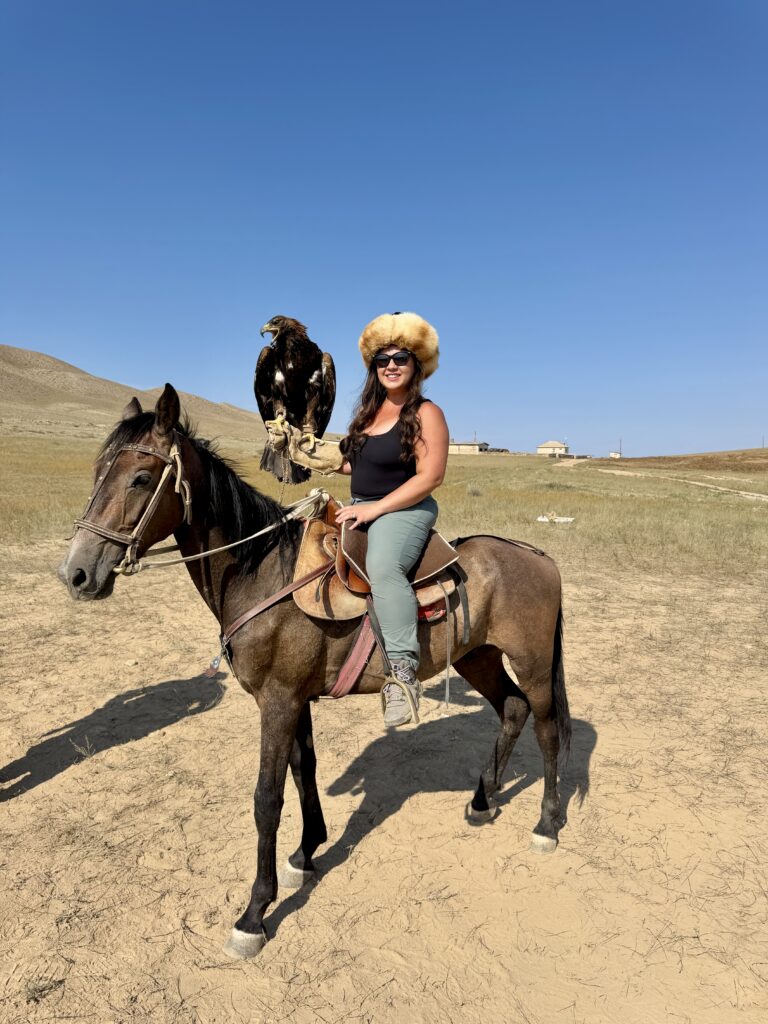
Next up was the highlight of the day: an eagle hunting show. We met local hunters and their eagles and watched a demonstration of this ancient Kyrgyz tradition. They showed us how the eagles are trained to hunt, and how they raise the eagles alongside a hunting dog. We got to hold and pet the eagle, and even tried our hand at archery.
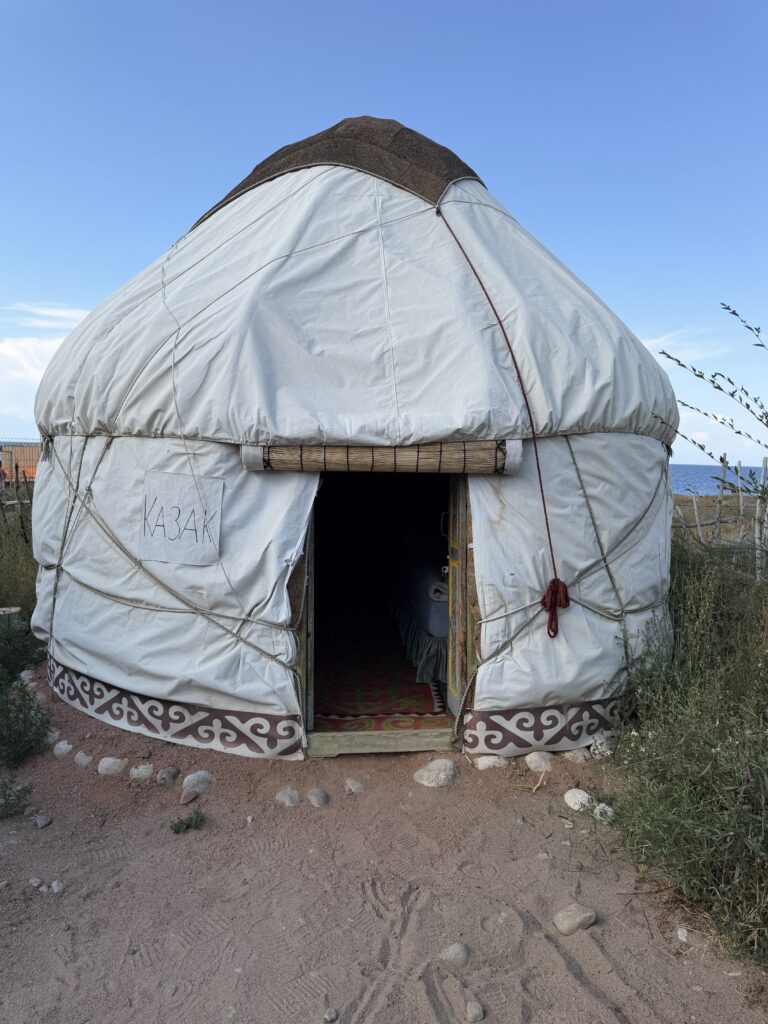
That night we stayed in a yurt camp right on Issyk-Kul Lake — traditional nomadic accommodations with two beds in our yurt, a shared co-ed bathroom, a restaurant, a bar, and plenty of places to sit outside. Issyk-Kul is the second largest alpine lake in the world, about 110 miles long and 37 miles wide — big enough that it looks like an ocean. Its name means “warm lake,” because it rarely freezes despite its high elevation and cold winters. We went swimming (yes, even Jamal), surrounded by mountains in water that was crystal clear. Dinner at the camp included traditional Kyrgyz dishes and a traditional dance performance, and our guide brought us wine to share in the bar area afterward.
Day 3: Fairy Tale Canyons, Barskoon Gorge & Hot Springs
We woke up early to watch the sunrise over Issyk-Kul before breakfast at the yurt camp.
First stop was Skazka Canyons, which translates to “Fairy Tale Canyons” — a colorful landscape along the southern shore of Issyk-Kul known for its dramatic red, orange, and yellow rock formations. Wind and erosion have shaped the rocks into castles, animals, and other whimsical shapes. We hiked with Azamat to panoramic overlooks, spotted a formation that looked exactly like a dragon, and took in colorful hills that reminded us of Badlands National Park.
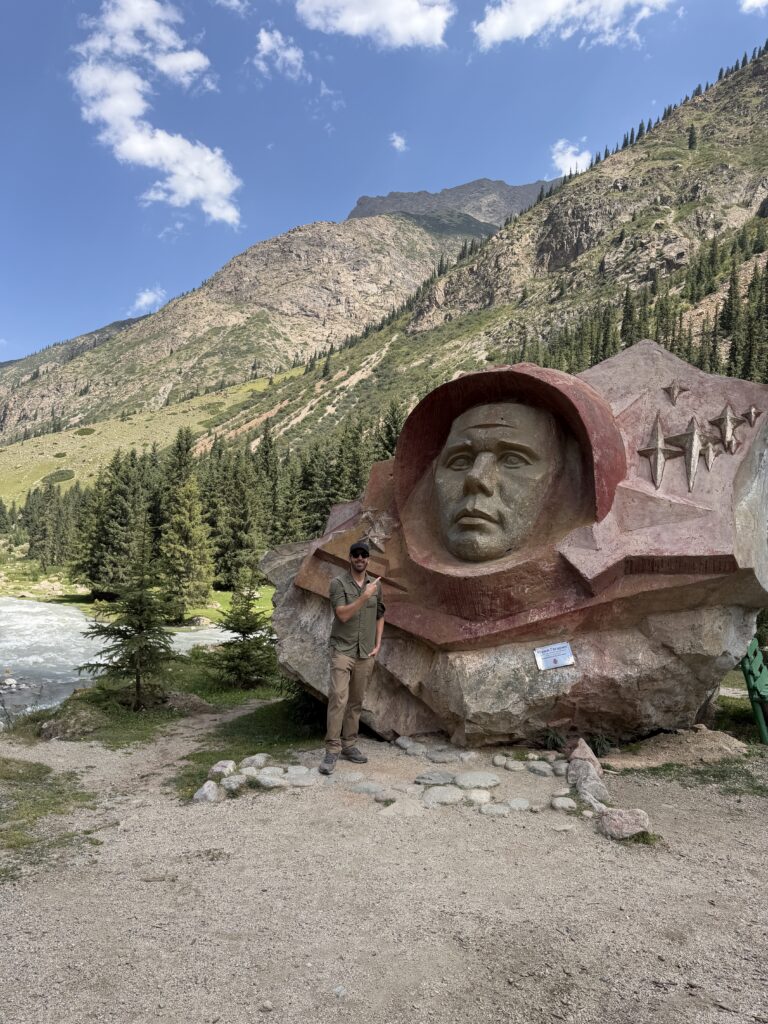
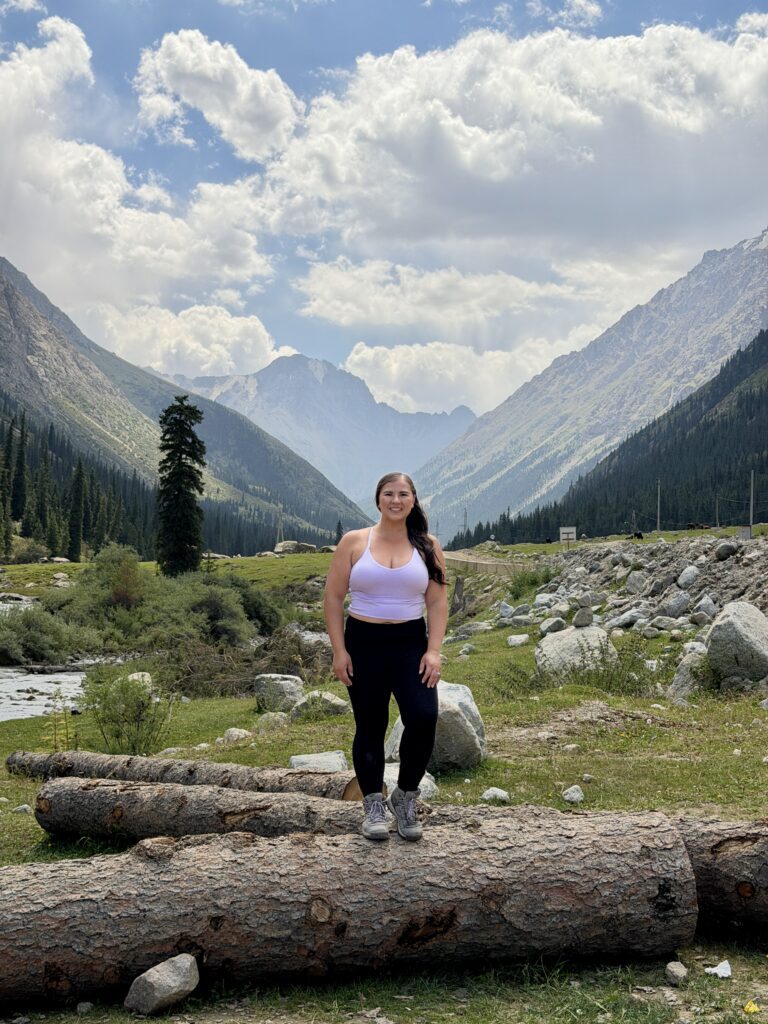
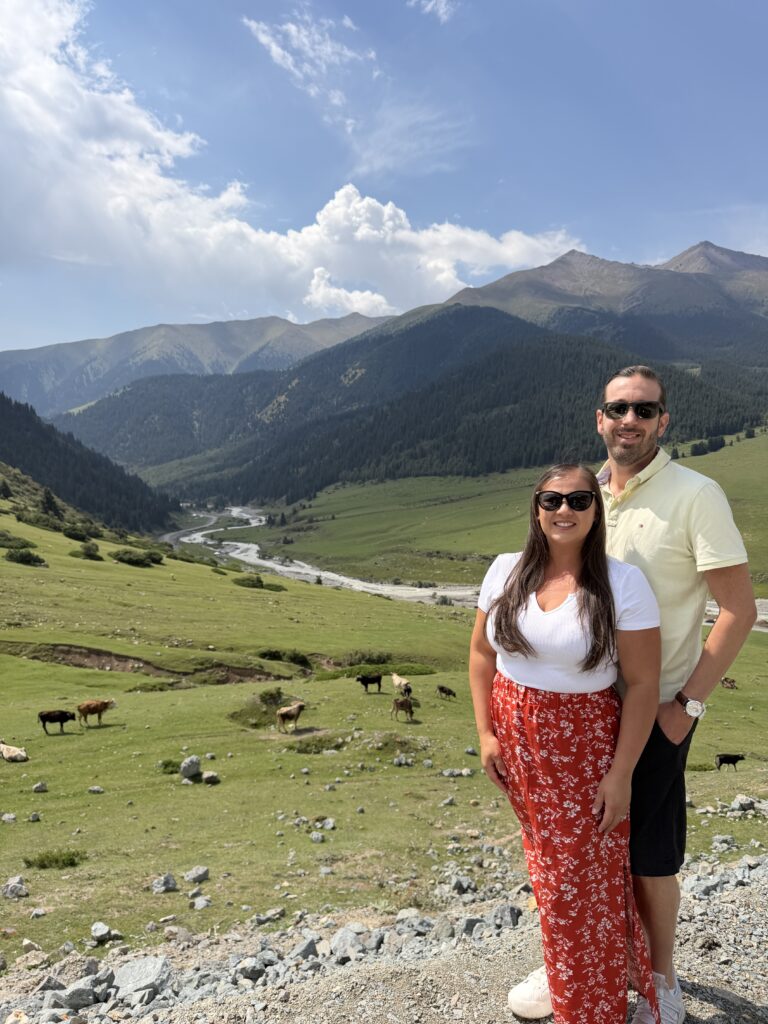
From there we headed to Barskoon Gorge, a beautiful mountain valley surrounded by towering peaks, lush forests, and rushing streams. We hiked partway up to Barskoon Waterfall, passing rivers, waterfalls, mountains, and meadows the whole way — it reminded us of Montana or Colorado. Down near the river we visited the Yuri Gagarin Monument, honoring the first human in space. Gagarin visited the Issyk-Kul region after his historic 1961 flight and spent time recuperating along the lake’s southern shore, and the monument is a unique piece of Soviet space history.
Next was Jeti-Oguz Gorge, which translates to “Seven Bulls.” We drove up to a panoramic viewpoint with towering cliffs that get their name from their resemblance to seven giant bulls standing side by side, surrounded by lush green valleys and forested mountains that contrast with the deep red rock. It reminded us a bit of Arizona. We grabbed a mid-day coffee at a shop near the top before dropping our things at the hotel.
We wrapped up the day at Ak-Suu Hot Springs — a natural hot spring area with manmade pools, including a children’s pool, three interconnected pools ranging from scorching hot to comfortable, a cooler pool along the river, and steps down to the river where a pipe pours in cold water. Dinner that night was at Dastorkon Restaurant, easily the best meal of the trip: borsok (fried dough), ashlyan-fu (a cold, spicy noodle soup), lamb, beef, and chicken skewers, and fried eggplant.
Day 4: Karakol, the Gorges & Back to Bishkek
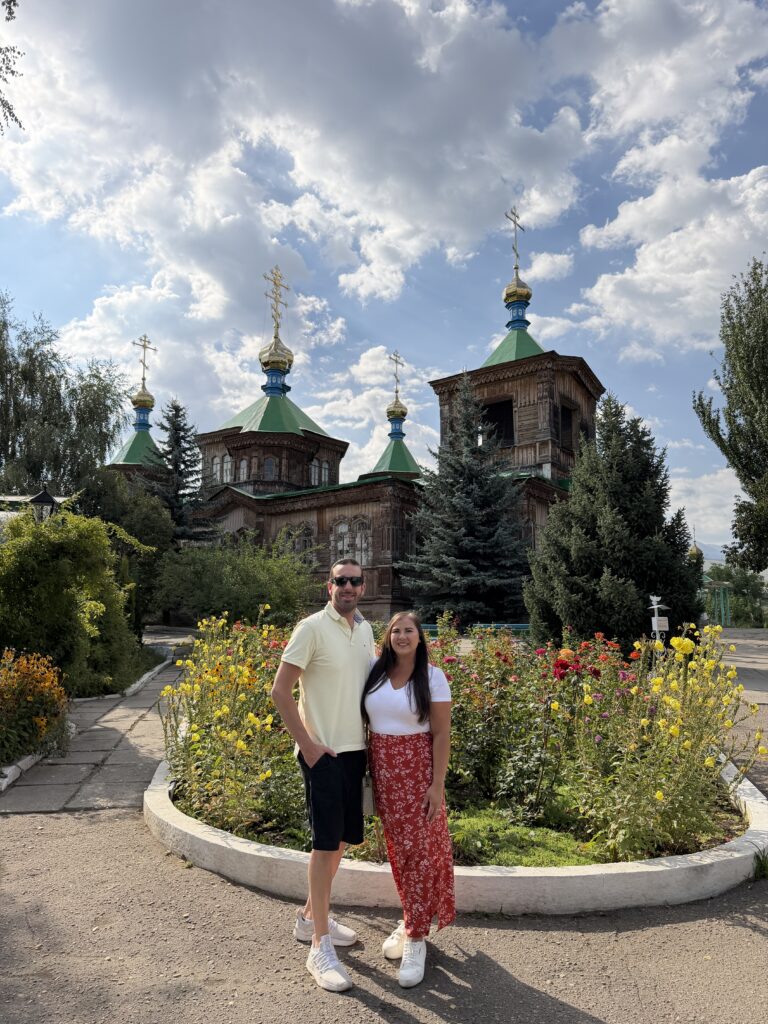
Our last full day started in Karakol, where we visited the Holy Trinity Cathedral, one of the city’s most beautiful and recognizable landmarks. Originally built of stone in the late 19th century, the church was later destroyed by an earthquake and rebuilt in wood, giving it its distinctive colorful, ornate look with bright blue domes. From there we visited the Dungan Mosque, known for its colorful wooden architecture and Chinese influences. Built in 1910, it was constructed without a single nail and features intricate carvings and decorative details inspired by Chinese temples.
We then drove through Semenov Gorge and Grigoriev Gorge, two of Kyrgyzstan’s most picturesque landscapes, surrounded by majestic mountains, lush forests, and flowing rivers. This is also where the World Nomad Games are held — an international sporting and cultural event celebrating traditional nomadic sports and heritage, including horseback sports, wrestling, archery, falconry, horse racing, and traditional games. (This is also where we came across the worst toilet of the trip.)
Next was the Ruh Ordo Cultural Center in Cholpon-Ata, a unique cultural and spiritual center on the lakefront featuring sculptures, gardens, chapels, artwork, and monuments representing different religions and cultures, plus a nice pier to walk out on. From there we took a boat tour on Issyk-Kul Lake — about an hour total, with 20 minutes out into the water, 20 minutes of swimming, and 20 minutes back to shore, all with stunning views of the surrounding mountains and crystal-clear water.
Our final stop was the Cholpon-Ata petroglyphs, an ancient open-air gallery of rock carvings dating back thousands of years, with a marked path to walk along. Then it was the long drive back to Bishkek (Britt slept the entire way), arriving right before 8pm and checking back into the Sheraton Bishkek, booked with Marriott points.
Final Thoughts
Kyrgyzstan completely exceeded our expectations. Between the canyons, the yurt stays, the horseback riding, and the hospitality, it’s one of the most rewarding off-the-beaten-path destinations we’ve visited — and it’s still relatively undiscovered. If you love mountains, nomadic culture, and adventure travel, this one belongs on your list.
0:35
Welcome to this week’s episode of the Travel Squad Podcast.
Today we are taking you on an amazing private four day tour around Issaquah Lake in Kyrgyzstan.
0:53
You know, when we told people we were going on this trip to Kyrgyzstan, a lot of people said, why are you going to Kyrgyzstan, Right.
It’s one of those countries that maybe you’ve heard of, probably can’t even pinpoint it on a map and maybe why are you going there.
But we love nature and people don’t realize there are lots of mountains of great nature here in Kyrgyzstan.
1:12
But in fairness, we did have a reason.
We had a squad trip that we were all going to be doing when we were going to Kazakhstan for the T Bex event.
And so when we decided all as a squad that we were going to Kazakhstan, Brittany was like, well, where in the region can we actually go?
1:28
And after doing all of our research, Kyrgyzstan really stood out to us.
That would be most intriguing to me and Brittany Kim, you were invited on this one.
You did not come.
You opted to do something else ahead of time before we all met in Kazakhstan.
And I will say, Kim, I do think you really missed out because Kyrgyzstan was really fun, really great place to go to just kind of have isolation, get into nature, and it was a really, really fun time.
1:54
I think if you’re looking for a trip like that, to be in nature, to be around beautiful scenery, to be in a very unique culture that you don’t come across too typically in the US, Kyrgyzstan is amazing.
It wasn’t the type of trip that I was looking for.
And I got to hand it to you guys.
2:10
You certainly tried your hardest to get me to go.
And I did look beautiful after the fact.
I saw your pictures, I saw the experience.
I know it was very affordable.
I know it was really close and and therefore easy then to get to Kazakhstan.
So there was little parts of me that kind of regretted not going, but I’m excited to really hear about it in detail.
2:30
And then after going to Kazakhstan, I have learned so much about the other stands in the area that I originally thought when am I ever going to go back to the stands?
But now I do think I will find myself back in the stands at some point.
You know, after we had gotten back from this trip and there’s quite honestly, it was a few days ago, Brittany and I were driving somewhere for dinner and she was looking on Instagram and she said that she just came across something that listed Kyrgyzstan as one of the best places for solo travel in 2026.
3:05
And in the moment, I didn’t tell Bernie.
Oh, like, remember what source this was.
So it’s what some sort of like travel blog, travel resource, but they designated Kyrgyzstan as the best place for solo travel.
So this is a place that’s really up and coming for travel.
3:20
And rightfully so.
We had a great time, so I wish I could name that source for you, but I can’t.
But we did see it that some travel news source did rank it that way.
And on that note, as we were going on this trip, you know, like I feel like people have a lot of misconceptions about the stands in general.
3:36
Oh yeah, people were were asking us like, why is it safe?
A whole bunch of different questions.
I have to hear one more comment about Borat too.
You say one thing about the stands and then that’s all people talk about.
Yes.
And so it was just one of those things where when I was actually on this trip, I was like, oh, I could do this as a solo traveler and I would feel comfortable as a woman doing this alone as well.
4:00
And I don’t think that’s out there enough.
So we’re here to tell you all about our trip.
Put those misconceptions and possible stereotypes aside.
So let’s tell you a little bit about Kyrgyzstan as a whole.
Like I said before, maybe people don’t even know where this is on a map.
It’s located in Central Asia, and it’s known for its rugged mountains, turquoise Alpine lakes, beautiful valleys, and its classic nomadic traditions that once formed this country.
4:28
And there are still nomadic people here.
But of course, within the cities, it is very modern, so to speak, and not anything that’s going to be too jarring for you to travel, right?
But they still do have nomads here, and more than 90% of the country is is actually mountainous, with the Tea and Sean Mountains providing just a beautiful backdrop almost everywhere you go within the country.
4:50
Yeah, so we’re gonna get into our four day tour, but our tour guides name was Azamat.
And we were talking to Azamat about how he got into being a trip guide or trip leader.
And he was like, I don’t know, someone just asked me if I wanted to take people out and, you know, I speak English.
5:08
And he was asking the person like why do they want to come to Kyrgyzstan?
And they’re like they want to come to see the mountains.
He goes the mountains.
Why do they want to come see the mountains?
He was like so confused because 90% of the country is mountainous and that is his backyard that he sees every single day.
5:24
So he was like, why do people want to come?
And it was just like a really funny conversation that we had because he didn’t realize that Kyrgyzstan really is special with all of its nature and beautiful mountainous backdrops.
Yeah, and it really leads to a bunch of opportunities for, again, those good outdoor adventures like hiking, horseback riding, camping and exploring those remote mountain landscapes.
5:48
And like I said, they are known for their nomadic history and culture.
So also you could do little glamping.
We even stayed someplace, which of course we’ll get into where we stayed in traditional yurts.
We saw eagle hunting demonstrations that the nomadic tribes did centuries ago and still even to this day.
6:07
So you get a lot of old and new when you’re visiting here.
But one thing that it’s I knew but didn’t really like place it until we went, is that Kurdistan is an old Soviet territory.
So everybody there speaks Russian.
6:26
The signs are in Russian.
So yes, they have their indigenous language, Kurgis, but you’re really only going to find people speaking those in remote villages.
Our guide Asimah was telling us pretty much anywhere that’s populated everything is in Russian, which I thought was quite interesting but obviously makes sense.
6:44
And we talked a little bit about why we picked this, but we love hiking, we love outdoor adventures.
And this just seemed like a really great trip for us.
We flew into the capital city of Bishkek.
We spent a day there and then we embarked on a four day adventure around Issaquah Lake.
It was a private guided tour, so we did have our guide, his car and our stuff, and he took us around the whole area.
7:07
And it’s very interesting to go to a place that is starting to become like viral in the moment because I feel like just in this the last few months or this last year, I’ve really seen Kyrgyzstan pop off.
Do you think?
That’s because of the algorithm though, and you’ve been looking at it.
7:24
It probably is because of the algorithm.
I don’t mean to speak for Brittany on this, but I want to answer your question.
I do think obviously because I say all the time, the algorithm is crazy.
I mean it knows stuff that I even think without saying or Google searching stuff, right?
But I’d really do believe that it is popping off.
7:40
It is about to be a very popular tourist destination.
The country is building up for it right now and we saw it while we were there, so they are expecting it.
I know just from folks who were there for Teabex and then explored the other stands, that’s hundreds of travellers of platforms that are about to put these stands on a larger platform.
8:02
And I do think that it will become much more popular in the coming years.
But I don’t think you’ve mentioned yet anything about cost.
That was one of the biggest appeals of this tour.
You had a private tour.
Just you, Jamal, and your tour guide tell the squatty’s how much it actually cost.
8:18
So it only costs $725 per person lodging for this pick up from our hotel, drop off at our hotel, all transportation, all entrance into all of the activities we did national parks, the Eagle show that we did, all of our stays, all of our food, everything was.
8:37
Four days, Three nights.
Yeah, four days, three nights.
The only thing that wasn’t included was occasional bathroom stops where we had to pay like in local cash, which was like no more than $0.50 a stop.
But otherwise everything else is taken care of.
What is steel?
8:53
What is steel for sure.
And so we landed in Bishkek.
Again, like Brittany said, we only spent one day there before we embarked.
But stay tuned for this Friday’s upcoming episode where we talk about our day in Bishkek.
So we’re going to save Bishkek for the Just the Tip episode this Friday.
9:12
For this trip, you flew into Bishkek, Kyrgyzstan and the airline that you flew was Turkish Airlines.
Squaddies, wouldn’t you know that Turkish Airlines is one of the top airlines that have deals on Thrifty Traveller through their premium subscription service.
No joke, you can save a ton of money on your flight, which is the most expensive part of this trip is getting all the way over there.
9:34
So use our promo code TSP.
You’ll get $20 off your first year subscription of Thrifty Traveller Premium and you can score a really good flight deal.
Yeah, just like you said, Kim, we flew to Bishkek, it’s Manus International Airport, and we flew with Turkish Airlines from LAX.
9:51
From LAX we flew direct to Istanbul and we had a layover there.
And then from Istanbul, we flew straight to Bishkek.
So before we get into talking all about our tour and the four days, you know, we always like to start you guys off with some tips.
So tip #1 for you is going to be the best time to visit.
10:09
And honestly, it’s going to be summer because this is an outdoor nature country.
So it’s the best time to visit for hiking, camping, that horseback riding that we talked about, swimming in the lake itself.
Yes, it’s going to be a little bit hotter, but truly this is going to be the best time to come is during summer.
10:28
Another tip for you is to get an E SIM or have a data plan.
You’re going to need this for apps like Yandex Go, which is the rideshare app.
You’re going to do this for navigation apps, translation apps, etcetera.
Not so much when you’re on a private tour, but if you are staying in the region in general, you’re going to need an esim or have a cellular plan that includes data.
10:46
We have T-Mobile, we have 5 gigs free every single month, so we were able to get by with that.
But if not, you would want to purchase an esim and we’ll link one in the show notes.
And if you don’t already have it downloaded on your phone, download WhatsApp.
It’s used to communicate with restaurants, tour operators, service activities.
11:03
So again, if you go and don’t do a private tour, you’re going to want this.
There was even a situation where we were looking at a restaurant on a free day.
I believe it was actually in Kazakhstan.
Maybe it was in Kyrgyzstan.
I can’t really remember.
Brittany.
But you emailed or messaged the restaurant via WhatsApp and they sent you the English menu because only online they had it in Russian.
11:23
So all the restaurants in Kyrgyzstan and other operators are all using WhatsApp.
Also, be sure to download offline maps, especially if you’re exploring independently.
The trip that we’re going to talk about that we did for the four days, we saw people do it on their own without a guide.
11:39
So if you are doing that, make sure you have offline maps available.
You can also download the language in Google Translate so you don’t need data for the Russian translations.
That’s very true, yes.
You could also download the language, I forget that as a good tip when we go international places.
11:56
That’s very good.
Another tip for you guys is bring cash.
Credit cards are accepted at many of the hotels, restaurants and larger businesses that you’re going to come across.
But cash is really useful for smaller restaurants, markets, local shops and definitely for using public restrooms.
12:14
It is like you’re up here, even though we are in Asia, you have to pay to use them, their local currency.
It’s called the Kyrgis Somme.
And like Brittany alluded to earlier, no more than $0.50 to use the bathroom and that’s on the high end.
It was actually a little bit cheaper when you do the conversion.
12:30
So I did like that, but you do have to pay.
You want a little bit of cash?
Either change it beforehand or pull it out from an ATM.
On the subject of toilets, make sure to carry toilet paper and hand sanitizer.
Public restrooms may not always be stocked with everything that you need.
And we mentioned this earlier, primary language is Russian, so you want to baby brush up on a few key phrases with Russian so that you can get around a little bit and communicate.
12:57
But on the theme of just travelling in general, we want to give this chip.
Try the local food.
They have a lot of other foreign cuisine in the restaurants there, especially when you’re in Bishkek.
But do you try the local food?
It is really good.
They have dishes like caramel, which is a fried flaky dough bread that they serve with the cream sauce, really delicious.
13:16
Borsock, which is a fried dough.
It’s almost spike unsweetened pancake, but super, super good.
The Log men, a noodle meat and vegetable dish, Monty, which is the dumpling dish, and samsa, which you could really kind of equate to samosa.
So they really do have good local food.
13:33
Don’t be afraid to try it.
And try a cup of traditional tea.
The tea is so good while you’re out here and our last few tips is about whether and sun exposure, especially if you are going to go in summer like we recommended, pack layers because it could be very hot in the valleys but cooler in the mountains and there’s going to be a lot of sun exposure on this trip.
13:52
So pack hat, sunscreen, sunglasses, everything to help keep you cool and protected from the sun.
So getting into the trip again, we mentioned that we did book a four day private tour.
We did it with a company called Dotka and we’ve linked it in the show notes for you guys.
14:09
However, like we’ve kind of already said, you can do this trip by yourself if you rent a car.
There’s more logistics involved if you do that.
We’re not discouraging you from doing that, but we enjoyed our time with Dotka.
You don’t have to think about it and it was a great experience and we would highly recommend you guys do that.
14:26
One thing that I did like is once we booked, they told me that I would have like a little person to communicate with on WhatsApp.
So they told us like who our tour coordinator was and if you asked her any questions, she would just what’sapp you back with a message and tell you and answer your questions.
And then as we LED up to the trip, she gave us our information on who our tour guide was going to be, what their name was, and logistics for the trip.
14:49
So day number one, we got picked up at 8:00 AM by our guide Asamat.
He was super friendly, personable, we really loved him.
He did speak great English, he was funny, he was a great guide.
I mean of course we got closer to him on this four day tour, but great impressions right away.
15:09
First stop on our tour was the Burana Tower.
The Burana Tower is 1 of Kirgit Stan’s most important historical landmarks on the journey between Bishkek and the Issaquah region.
So this used to be a mosque and it’s an 11th century minaret and all that remains is like this tower.
15:26
It was once the ancient city of Balasagun, and it was a trading center along the Silk Road do.
You know what the Silk Road is, Kim?
Or I’ve ever heard that term before.
Yes, of course, I don’t know all the deep history of it, so why don’t you share a little?
15:44
Well, I’m not going to go too deep history of it, but really what it was, was a trading route between East and West all the way really from Eastern China all the way into Europe.
So these countries in Central Asia, they had a lot of stopping posts for people as they were trading goods, cities that develop etcetera.
16:03
So this is kind of one of the remnants of the cities on the Silk Road.
So I think you said, Brittany, that the tower originally stood much larger.
Maybe you didn’t.
I can’t really recall at this point.
But nevertheless, it’s a little shorter now because this area is prone to earthquakes.
So with earthquakes and centuries of weathering and reconstruction, the height is lower than what it once was.
16:24
But it’s still really cool to see this ancient structure.
It’s really the history that’s there for it.
But what’s really cool is in this area, as you’re working your way to the isical region, which is up in the mountains, you are still still in the valley.
So when you’re up in the minaret and the tower, we were able to go up and climb it.
16:42
You just get beautiful 360° views of the surrounding mountains around you to just give you a little glimpse of what’s to come once you get in there.
And it’s just like really beautiful.
These are like rugged, jagged mountains still having snow covered peaks.
And what’s really cool, I haven’t mentioned this yet, is in these mountains, they have the elusive snow leopards.
17:01
I knew it was going to be very rare.
That and a small likelihood that we actually encountered one or saw one we did not, but it’s cool to know that they are in there.
While we were at the Burana Tower, we did climb up, Jamal mentioned that we went up in there and it is a little claustrophobic.
17:17
So if you’re afraid of that, just keep that in mind.
And it’s a very, very narrow and very steep.
I was literally using the steps almost like a ladder because of how steep it was and how tall the steps were inside.
But it’s worth it to go to the top.
17:33
You won’t be up there for very long, maybe just a few minutes and then head back down.
We got there pretty early in the morning, so it was nice that it wasn’t crowded and there were no other groups there.
But also on the site here, there’s like a little museum where you can see artifacts that have been found in the area.
17:48
There’s also these ancient stone carvings known as ball balls.
And there are these archaeological remains and grave markers.
So there’s no graves at this site, but they found these archaeological remains throughout the region, brought them here for preservation.
And I just thought it was like a good, interesting stop.
18:06
We were here for no more than like 45 minutes.
So after the Burana Tower, we made a stop to get tea and katama, which again is that traditional Fergus flatbread that’s really flaky, deep fried, so delicious.
And then like I said, they serve it to you with a heavy cream of sorts.
18:24
It’s not really sweetened like heavy cream here in the US, but you just tear it apart, dip it in.
It was really good.
Had their traditional tea that they had.
And apparently this area where we stopped is a famous spot to go where they have.
How many shops would you say there at least at?
18:41
Least 10.
Well, ten, I was going to say they had at least 20.
I mean, maybe even more than that, but nevertheless, a lot of these shops selling the Katama bread and having tea, and it’s one of the pit stops that even local people have as they’re going up into the Issaquah Lake region.
18:57
So it was nice to just get into the culture a little bit and eat some traditional food and have tea at the spot.
I never found out the reason why, but they drink tea out of bowls and not cups.
And so originally when we were getting sat, there was like a bull in front of me and I was like, oh, I wonder what this is for?
19:13
But that’s where they poured the tea and we’ve got to watch the make the traditional tea outside the shop as well.
Really, really delicious.
So after we had like this little snack, we went hiking.
And in summer it does get hot, especially in the valley.
So we were hiking in 90 plus degree heat.
19:30
It was actually kind of awful, but our guide was like, do you want to do like a really short hike, like 30 minutes, or do you want to do the longer one?
And we’re like, how long is the longer 1?
He said three hours.
And we’re like, OK, well, which one gives a better view?
He goes well, the longer one more so.
19:48
Of course.
So again, the stop of where you’re going to be going is going to be the corner check Canyon in the Boom Gorge.
So that’s the stop, but depending on what you’re desires and once are you have that option of do you want to do the shorter one or do you want to do the longer one?
20:04
Leave it to Brittany.
Of course I knew she wanted to do the longer 1 and in reality I did too.
But in that heat I was thinking, oh man, maybe the 31 will be sufficient.
But I also thought to myself, what the heck man, I’m here.
When else am I going to see it?
I could deal with the heat.
We were starting to get our way up into the mountains.
20:21
We weren’t high enough yet for the temperature to to drop to a comfortable level, but I was like, all right, we’re going to do the long one.
But it was.
Really cool because where we arked off the side of the highway is the start of the trail and you’re working your way through and dried riverbed really, because this is a kind of river and wash run when the snow melts and creates a river.
20:45
By this point in time, it had obviously dried up, but you’re kind of going through these narrow canyons and then you had some sections where you actually had to do rope climbs, and then it opened up into this beautiful gorge and Canyon that was honestly reminiscent of being what somewhere like in.
21:02
In Bryce, I feel like Utah, the areas like very the, the sandstone is red and orange and it’s carved by, you know, the water and the wind.
And so there were structures that almost look like hoodoos.
The sandstone looked a little bit like Utah.
21:18
It was a really unique stop.
But we ended up hiking to a panoramic viewpoint, got to spend some time there.
And our guide was telling us that because you are hiking on this washed out riverbed in the winter, this freezes and it snows in this area.
21:34
So you can’t even do it until like a very late spring or early summer.
And so you can really only do this hike in the few summer months that it’s warm enough where the water is kind of dried up and there’s no snow on the ground or ice.
Hence the reason why we said best time to visit during summer, because obviously the further up you go, the more things are going to be covered in snow, right?
21:55
And if that’s your thing, it would be really beautiful in the snow, but just not a lot of outdoor activities other than just admiring the beautiful visuals of the mountains covered in the snow.
So after the three hour hike and in the heat, we were going to be going to our stop of where we were going to be staying for the night.
22:13
But before we get to that, we did go to lunch, which of course was included on this tour.
One thing that I found, I don’t want to say like really interesting.
And again, maybe this is my own stereotype going in.
I mean, I know the country is developed now, is it USA developed?
22:28
No, obviously not, right?
But it’s not not developed.
But I was not really expecting along their highways for them to have so many good spots to eat that are designated for travelers.
Like, again, tourists are starting to do this, international ones that are coming, But a lot of the locals, they come here as their little vacation spot to get out of the city, escape the heat to the Issaquah Lake region, and they have such good food.
22:54
So the place that we went to wasn’t a specific restaurant.
It was a dining hall that was along the highway.
And we got to choose pretty much anything that we wanted that the dining hall had.
They had such good options.
And again, what I really liked about this tour was yes, foods included, but it wasn’t like, oh, you get one plate, it’s this or that.
23:14
Like if we wanted 10 different things from that dining hall, if we were hungry enough to eat it, like our tour would have taken care of it.
And I thought that was really cool.
And another reason why I would recommend dot cut like you will not go hungry.
I was not hungry for the entire four days.
I didn’t even get hungry till like a few days into our Kazakhstan trip, you know, it was just like we were constantly eating.
23:34
Let me ask him some questions about the logistics here.
With the food hall, is your tour guide just there to take cover?
Like when you pick what you want, you go to the cash register, he pays or OK, so that’s how it works.
And then if you were doing this trip on your own, not with the tour, what were the prices like for the food?
23:54
Very, very inexpensive.
Like honestly, everything in there was like under $5.
And that’s on the high end of things.
Like we got a whole like quarter chicken leg with the thigh, the leg on a bed of rice.
And that was like $4.00 itself.
24:10
And then that was like maybe one of the more expensive things, like if you like rolled cabbage, which I know is a popular thing.
And they do have a lot of Russians that come there.
And I know that’s a Russian staple just as well.
Like that was maybe a couple dollars.
So food and everything.
24:25
Like if you’re buying on your own, very, very inexpensive.
Even when we went to sit down restaurants, I don’t think I really saw anything unless it was like a rack of lamb that was over $7.00.
And if you’re getting good portion sizes, for sure.
Yeah, so by this time, this is like our third meal of the day.
24:42
We ate breakfast before our chore started.
We had the kadama and the tea, and now we’ve already ready for lunch, but we have lunch before we drove to our guest house.
And our guest house was actually in a National Park, was called Chown Camen National Park.
It’s in northern Kyrgyzstan.
24:58
And again, we’re in the rugged mountains.
There’s Alpine meadows, forests, rivers, valleys.
Our guest house actually has dinner included with it.
So we settled in and they basically said we had free time until dinner, which was I think at 7:00 PM.
25:14
So we did have a little bit of time, but the property itself was just really beautiful.
Jamal and I had free time, so we just kind of walked the it’s not even a town, It’s just like a a village.
It’s like a village, Yeah, I would say because you, again, you’re in a remote area of a National Park.
Yes, some people live there, but a lot of places in this village are what they call guest houses, which are geared towards tourism and people coming and staying.
25:38
And so when you stay at these guest houses, the dinner and breakfasts are included while you’re here.
So we really didn’t have to leave the property.
Exactly.
Is a guest house, is it a home, a typical home, or is it like a little hotel with like multiple guests?
25:55
Like what does it look like?
So I would say like it is a little lodge where there’s are a few different rooms, but the owners definitely have their own house on the property that they live on.
And they’re they’re running this this little lodge.
And then they have a kitchen and dining area that they’re serving guests breakfast and typically dinner as well.
26:17
OK.
I’m kind of imagining like the guest houses on the South Coast of Iceland.
Similar, yeah.
Not necessarily because those ones are kind of like open, like we had a courtyard area.
I feel like other guest house that I saw had that and it was really kind of like a square or rectangle.
26:36
And like our areas were like to, to get to our room was enclosed.
There was a hallway in there, There was multiple doors, there were steps up to the second level.
So it is like a hotel, but I would say it’s like a hybrid because again, owners are living on property.
26:53
But I think what makes it a guest house or the terminology they use in Kyrgyzstan for that is really it’s not just a hotel check in.
There’s like a lobby.
It really is a recreation place, so to speak.
And almost, I don’t want to say like bed and breakfast, but like a bed and breakfast.
27:09
Yeah, I was going to say like kind of like a bed and breakfast dinner.
Yeah, with the with the meals included in your stay.
OK.
And so we did have dinner included and they have a nice dinner.
We had Chinese salad, soup, chicken and rice dish.
27:26
And then I don’t know why, but they had the most delicious Raspberry jam and it was so good.
I am still dreaming of that Raspberry jam and we had it later in the trip to at a different guest house and it just didn’t compare to this.
One, I mean, it was still good, but if you had this Raspberry jam first, then you’re right, the other one wasn’t good.
27:46
But what’s really interesting is like one of the other places that we stayed, which was going to be the next night at the yurts, they always have the jam out on the tables because they always have bread with their meals, whether it be dinner, breakfast, etcetera.
So I guess it’s there as an accompaniment for your bread, right?
28:04
But what was interesting too is at the guest house and even at the dining hall where we were staying for the yurts, they had trays.
You’d like this, Kim, multi tiered trays.
It wasn’t like a high tea situation, but they had like hard local candies that were on there.
So it’s like a thing.
28:19
There’s always going to be jam and candies out on the table for you, which I thought was pretty cool, interesting and unique.
So after dinner we went to sleep, we woke up in the morning, we had breakfast included at the guest house, just a standard breakfast.
28:36
And then after breakfast we went and did a 2 hour horseback ride through the National Park.
And you guys know how much Jamal loves horseback riding.
I hate horseback riding.
That’s obviously sarcasm, Britney.
I really hate horseback riding, but in fairness I feel like the several times I’ve been on a horse.
28:54
It was donkeys.
Yeah, well, they were donkeys.
They were mules, right?
So they were smaller and I’m a bigger person.
Or if it was a horse, it was a smaller horse that still made it feel like a mule, which then makes it very uncomfortable, more particularly on my buttocks because I don’t have really a lot of fat on there to give me some cushion, so to speak, or muscle for that matter, right?
29:18
So like it’s sitting on a saddle is not very fun for me.
But I will say this, this horse was large, or at least larger than anyone that I’ve ever been on.
Large and in charge.
Larger than charge and the saddle itself was actually one of the most comfortable saddles I sat on.
29:35
Don’t get me wrong, at certain points I really had to adjust myself and try to get myself comfortable.
It became uncomfortable, but more comfortable than I’ve ever been on a horse.
So this was probably my most enjoyable horse riding experience that I’ve.
Had they’re just getting better and better.
So the next one you do, you’re going to absolutely love it.
29:52
I’m done on horses now.
Like I did this for Brittany and obviously because they’re it’s a nomadic culture, they’re really big into horses out here.
It’s one of the main staples of transportation, of course.
So I did it.
But I’m really done with horses.
I can’t think of any other place where I have any desire now to get back on a horse.
30:09
We met 2 girls while we were on our youth.
You’re staying there.
We’re asking them like what are you doing tomorrow?
And they’re like, oh, we’re going on a six hour horseback ride.
And Jamal was just like, Oh my God, that is my nightmare.
So this one was only two hours, and it was a very beautiful landscape in the National Park.
30:26
As we were horseback riding on our left, it almost looked like desert mountain terrain.
But then directly ahead of us while we were on this horseback ride, it was more like Alpine mountain terrain, more forested.
It was really, really beautiful.
We passed through creeks.
30:41
We took some pictures of the horses, the landscapes.
But you were mentioning Jamal’s horse, large and in charge.
His horse did not want to behave and Jamal would be like trying to steer it one way and it was like, Nope, it was making its own path and doing its own thing.
So his horse was a little rowdy.
30:58
Yeah, it didn’t want to listen to me.
Maybe it knows that I’m not a big fan of horses.
They can read energy.
Yeah, that’s probably what it was.
I was trying to go in there with good energy.
I mean, honestly, I went in with a great mindset of I’m going to have a good time.
Like Brittany was saying of the landscape, like we were in one area, but visually we had three different landscapes.
31:17
Again, that kind of desert mountain.
And then when she was saying Alpine valley, you have kind of that green grass on the mountains, not really forested, maybe just a little bit of shrub.
And then you could see the mountains a little further off that were actually like forested, you know?
So you really got the beautiful views, especially again with the creeks that you had and rivers flowing through.
31:36
It was just really beautiful.
So then we started to head along the southern shore of Istical Lake, which mystical lake?
The southern shore currently right now is under construction.
That whole Rd.
So it’s a bit bumpy, but it’s supposed to be done they say, by next year.
31:53
And that’s going to make it so much more enjoyable to drive.
But we ended up going to a village and forgive my pronunciation but it was called the Banco by Beho Village.
I’m going to say Bokom by Bebo.
32:08
OK, your pronunciation’s probably.
Better, maybe a little bit better, I don’t know.
Again, again, forgive the pronunciation on it, but again, this is a village that is on the shores of Issacol Lake, and we’ve mentioned Issacol Lake a couple times.
So I just kind of want to give you a perspective of what we’re talking about here.
32:24
Issacol Lake is actually the eighth deepest lake in the world.
It’s the 11th largest lake in the world by volume and the second largest Alpine lake in the world, only behind Lake Titicaca in Chile.
So.
Or is it in Chile?
Or is it in Peru?
32:40
In Peru, excuse me, so a very famous lake, very large.
And what’s really cool here around Lake Isacol is you just have so many different landscapes.
And again, as we talk more about our tour and what we did, just so many different landscapes around this lake.
32:57
So we had done the horseback ride, we did our drive, we made it to this village.
We ended up stopping for lunch.
And one advantage of having a private guide versus doing a self drive is our guide knew all of the really good restaurants to eat at and he can recommend what to eat.
33:14
So we ended up sitting down at a restaurant.
We ordered a few things for lunch and what was really nice was the night before at dinner we were just kind of talking just about life in general.
He was telling us how long he had been married, about his family, and then we started talking about our marriage and stuff.
33:30
And we were actually on our 11th year anniversary.
So he surprised us with a cake for 11th year wedding anniversary, which was super, super sweet.
It had candles with 11 on it and everything, so I thought that was like such a nice personal touch to have and we would have never known about this restaurant on the side of the road getting there if it wasn’t for our guide.
33:53
So yes, you could self drive and it would be very, very, very affordable, but you wouldn’t know where to stop and he knew all the good places.
And we ate at a delicious restaurant.
And again, to your question, Kim, you know, we mentioned prices at the food hall equally as affordable here at this restaurant.
34:09
And it was really nice and maybe the nicest public restroom that we came across on our drive itself in this restaurant.
The only thing missing is the name of this restaurant.
I know we did not get the name unfortunately, so I apologize to you squaties for that.
34:28
When we do guided tours like this, we tend to forget to write down the names of the places they bring us to.
But squaties, we need to remember to do that for you on future guided tours.
Yes, or all the more reason.
Just book this tour with dot Cut.
So from here we ended up going to an eagle hunting show.
34:45
We got there a little bit early, so we got to watch the group beforehand.
There was probably like eight people ahead of us that were doing the eagle show and demonstration.
So we got to see that they were going to do archery skills and got to hold the eagle and a bunch of stuff like that.
And our guide was so funny because as we’re sitting there and this group ahead of us was doing the archery, he was doing like commentary and like commenting about how terrible their archery skills were.
35:11
And we’re like, wow, like we’ve never done it.
Like don’t say anything while we’re doing it and make fun of us.
He’s like, oh, OK, I’ll be quiet.
I won’t say anything or make fun of you guys while you while you’re up.
But he was really funny.
Yeah, so at the eagle hunting show, again, the nomadic history and culture that they have here in Kyrgyzstan leads to why we’re actually here as a cultural thing.
35:32
And I thought it was really cool.
We got to learn and see with the nomads how they actually capture the eagles when they’re young, they train them how to hunt, how they pair it with a specific local dog that is also good for hunting, that they do in a tandem to hunt for foxes, other jackals, other types of animals.
35:55
And so they will do demonstrations where somebody on the horse will ride the eagle like up the mountain.
You see him go super far away.
Then somebody else with a mock fake carcass, right, of an animal that they would hunt.
They’re riding it with the horse, kind of dragging it, and the eagle just comes from the top of the mountain.
36:14
You watch it and then he just swoops it up and grabs it.
And then they do that display with the dog just as well.
So I thought that was really cool.
And then of course, we got to try our hand at doing some archery.
Brittany went first and I knew Brittany was going to be good because I’m just going to say this and maybe some people won’t like it.
36:34
We own firearms and when we go shooting, Brittany is very good at it.
I had a great understanding that she would probably be really good at the archery.
We got five shots each.
All five shots hit the board no problem whatsoever.
So Brittany was very successful in that.
36:51
I felt the pressure on me because Brittany hit all 5.
Plus, I’m worried about what Azamat’s going to think of he because he was criticizing the other people ahead of us.
And I won’t lie, my first two shots missed not because I shot over the target or whatever.
37:06
My problem was, I was just really getting acclimated to the bow.
I wasn’t pulling it back far enough.
But once I got that, my last three shots were on target and dare I say, closer than any of Britney’s five that.
Made it.
I don’t know about that.
I’m going to count myself victor on this one.
No, no, no, no, no.
37:23
Fun experience.
And then after the archery, we got to hold the eagle sit on the horse just as well.
And this is the first time that I’ve really ever held an eagle.
You know, they give you the glove so that the talons and their claws don’t dig into you.
So it’s comfortable holding it.
37:38
But man is it really cool to hold such a big bird in your hand and it let us pet it and everything.
And I just absolutely loved it.
Honestly be one of my favorite experiences that we did on this tour was the eagle hunting for the display and then also just being able to hold the eagle.
37:56
Jamal has become a big bird guy in his later 30s and this is like the pinnacle of your bird fascination.
Did you not hear me when we were in Kazakhstan and we came across eagles because they have nomads there, too?
And I said that I need an eagle or like a bird as a pet.
Or was I just telling not to?
38:12
Brittany, I thought I said it out loud to all of us.
But like, I want an eagle now.
I mean, I’m really obsessed with the thought of having an eagle.
You may have to move out of your condo community before you get an eagle.
I know, I know.
Well, I won’t actually have it in the house.
What I really want to do, and I kind of wanted to do this with a crow, is create a relationship by putting stuff out for it for it to come.
38:33
But now.
You can do that, pigeon.
Yeah, yeah, I know, I know.
But now I really want.
To start with a pigeon.
Then you can graduate to something.
I’ll start with a crow and then I’ll step it up and graduate to the eagle.
That’ll be my plan.
But wow, how intimidating is it to hold the eagle?
38:49
Like they are huge.
Like you see them flying in the air.
They don’t look so big.
But when it when one is sitting literally on your arm and it’s like making eye contact with you and you can see how big and powerful it’s beak is and you’ve just watched it hunt, it’s kind of intimidating.
Oh.
Yeah, they’re heavy too.
39:06
They’re 30 lbs.
I don’t know.
They’re they’re big.
They are.
They are quite large and like Brittany said, they don’t really look big when you’re looking at them fly, but when they’re up close and you see the wingspan on it, you just realize how impressive these creatures are.
So after the Eagles show we ended up going to the yurt camp which is right next to Issaquah Lake.
39:27
It was a traditional nomad accommodation so there was 2 beds in our yurt but I saw some yurts hold up to four beds.
It would be a tight fit but they were a little bit bigger.
There is a Co Ed bathroom, so it’s not attached to your yurt, but there was a like legit bathroom structure had four stalls, a sink, Amir.
39:45
There was also showers.
There was 4 stalls of showers that was just kind of like perpendicular to the bathroom stalls, each of them private.
So that was nice as well.
And then on the opposite side of that was a sink area with like 2 faucets and a mirror.
40:01
So there was plenty of space to get ready and decompress and all of that.
Also on the your camp property there was a restaurant which is where we ate breakfast and dinner and they have a bar attached to that and there are little places to like sit out.
So they would have like tables and chairs out or other places to sit where you can just relax.
40:19
There was a hammock, there was like a swing chair and we were very close to the lake so we could actually go down.
In swim there, which we did later this day.
Yeah, I loved how close we were to the actual lake.
So once we had gotten settled in, we decided that we were going to go swimming in the lake.
40:37
And I was concerned.
It’s an Alpine lake.
How cold is it going to be?
You know me, I don’t like cold water.
But we were talking about it on this trip, Kim, again, more particularly, I guess, when we all finally met up in Kazakhstan, Antarctica, Right.
We’re going to do the polar plunge.
40:53
I know this is going to happen someday.
So and getting my cold water tolerance.
So I was like, all right, I have to get in the water.
And like I mentioned earlier, second largest Alpine lake in the world.
I mean, it’s so big.
It really looks like an ocean.
If you’ve ever been to the Great Lakes and look at it and you know, you can’t really see across and it looks like an ocean.
41:12
You get that same vibe here at Lake Issaquah.
It’s 110 miles across, 37 miles wide and its name translates to warm Lake.
And it’s not really warm, but they give it that name because it rarely freezes despite the high elevation and cold winters that they have.
41:31
So that’s again what the the name Issica Lake means really warm lake, but again, just really beautiful surrounded by the mountains.
And it was an enjoyable experience swimming.
And we ended up swimming with Ozima just as well.
And he went out far and deep, just diving in, really enjoying his time out at the lake.
41:52
And as we were too, Yeah, I was actually surprised.
Jamal went swimming because the water was a bit chilly, but it was nice and refreshing, especially after hiking earlier in the day and it being so warm, but you’re just surrounded by the mountains.
The lake water was super, super clear.
There are other yurt camps right on the shore, so it just makes for a really beautiful backdrop.
42:12
So even if you just wanted to lay out and enjoy the nice warm weather, you could do that here as well.
But we did get in for probably about an hour or so before we had to make it to dinner at the yurt camp.
Yeah.
So we showered in the.
Communal showers that they have again, individual stalls.
42:29
We got ready for dinner.
It is at camp.
Did you notice that they made the restaurant area almost look like a yurt when you walked into a circular?
Kind of had the tent thing.
So I thought that was pretty cool.
Just really keeping with the theming.
We had a really good dinner.
42:45
They brought out traditional food.
I don’t remember what specifically it was, but everything was just so delicious.
Yeah, we met 2 girls from.
Norway this day they were on an 8 day private tour around the region and they were the ones that were going to do the six hour horseback ride the next day.
43:04
They were really fun to talk to.
They had just booked the trip like no more than a week in advance before they went, so they just booked something online and found an 8 day tour and showed up.
Yeah, and I forgot to mention dinner.
Here at the yurt camp is traditional in the sense that we were sitting on the floor just as well, no shoes on or anything, no tables or I shouldn’t say no tables, no chairs, excuse me, sitting on the floor, which I thought really enhanced the experience.
43:31
But earlier on our tour, Azimat was asking me and Brittany do we drink?
And we said yes.
And so he surprised us by buying a bottle of wine.
So after dinner, we went out to the bar area and we shared and had a bottle of wine.
And we’re just fucking at this point in time too.
43:48
It had become dark, the sun had set and you are in an isolated area.
So the night sky out here was just equally as beautiful as the surrounding areas that you could see during the day.
And I really do love and appreciate when you’re in a place where there’s not a lot of light pollution, you can actually see the stars.
44:05
And you got that experience here.
Like, they do want a lot of tours.
That we’ve been on.
They did a traditional dance and song.
Jamal did not want to participate.
Were they calling for the crowd?
To join it, Yes, they were they.
Had a little dance party outside and there was even a map like right outside of the restaurant where you could take a pin and put where you’re from.
44:24
No one from San Diego had been to the Sierra camp, so we got to put like our little pin in, which was really cool.
We enjoyed the wine.
Was it Kyrgyzstan wine?
It was.
It was.
So they have a wine region out.
There, they definitely do.
Yes, they did.
It was good wine.
44:40
Too, We ended up finishing the bottle got a little buzz before going to bed and in the bar area.
Like the family that runs this yurt camp obviously lives here as well.
So there was there was a baby that was around the property.
So I got to hold the baby.
She was so cute and chunky.
44:56
She was really cute actually.
So we just got to just enjoy and relax the rest of our night, which what I really liked about this tour was we didn’t start breakfast until 8:00 every day.
So we didn’t leave leave the accommodations till about 9 and dinner was at like 7 every night.
45:12
So by the time you’re ready to like relax for the night, it’s like 8:00 PM versus some other tours where like you’re just go, go, go and try to like sleep every opportunity you can.
This was like a relaxed pace, really good pace.
All right, day three of your.
45:28
Tour.
What do they have in store for you?
Well, this day we were going to.
Do some hiking.
But we woke up a little early naturally, and I told Jamal, like, do you want to go catch the sunrise on the shore of the lake if we can.
How early are we talking?
45:45
What time was sunrise?
Like 545?
Yeah, I think 545 actually.
Take that back, I think.
No, it was six O 5.
It was 6.
O5 and I said.
If we go out there, I won’t get out there before 545 because I don’t really like when it’s still dark and watching it.
46:00
Like I don’t mind the sunrise, but I’m not getting there that early.
I was like, I got 20 minutes for you before the sun rises to just enjoy it and then we’ll kind of go from there.
So it wasn’t terribly early, but honestly, like we’re tired from everything that we’re doing.
46:16
We’re getting in early and calling it a night early.
Like Brittany said, just because this tours again, we are doing a lot of stuff, but enough time to rest.
So waking up early wasn’t actually too hard.
I think we both kind of woke up naturally at some point and we’re just like, all right, let’s go.
46:32
I think I might have.
Been texting with Brittany this morning and it and you had said like it’s like 4 in the morning and I’m up and I don’t think I’m going back to sleep.
Could have been this.
Morning.
I’m not sure, but yeah, we got up, I looked at Jamal and I said do you want to go watch the sunrise?
46:47
And he told me a time and we just walked down to the shore and watched it and it was a very beautiful sunrise on the water.
And then we had.
Breakfast at the yurt camp before we packed up for the night and started to do what our tour had planned for us.
47:03
So our first stop was going to the Skoska Canyons and that actually translates to fairy tale canyons.
And it’s a really colorful landscape along the southern shore of Issacol Lake and the region known for its dramatic red rocks, orange and yellow formations that they have wind erosions that have shaped the rocks into almost like castle and animal like whimsical structures.
47:28
So it’s really cool.
We hiked of course, with Ozma.
He took us to the panoramic overlooks.
We spotted a formation that looked like a dragon because of the how the rocks are formed in the ridges.
It almost looked like the spine of a Dragon’s back as it would be laying down an area in the front almost looked like its head as well.
47:49
And just the colorful hills, it really reminded us of being in Badlands National Park here in the US, if anyone has ever been.
I mean, just really beautiful colors.
I don’t want to say you wouldn’t expect, but at the same time you don’t see a lot of places that varying degree of colors within the rocks in such a small area and I don’t even know that we actually.
48:10
Went on a specific trail.
If you were trying to replicate this, Azamat just knows all the good spots.
So he’d be like okay, we’re going to go over here and then we’re just going to like divvy around over here.
And then at 1 Fire we were making our own trail.
We went over like a little sketchy section because Jamal said he wanted to get closer to the Dragon Rock formation and like we’re scaling all these rocks and kind of like, yeah, we did our own version of bouldering.
48:34
Yeah, we did not follow a path.
And then Azimat realized, oh, this probably wasn’t the best way to go to get there.
In fairness, Brittany’s right.
He does know his ways.
But I said, oh, like, let’s possibly get closer to this if we can.
And it looked like we could.
But then if you go over the edge, you really can’t.
48:49
And that’s where Azimat went.
And so Brittany followed that.
I was like, no, no, no, I’m going to back up and go around the other way.
So I took the longer but easier way.
They had to do a little bit more bouldering and butt sliding to get down area that they went, but just a really cool area here.
49:07
Just with the formations and the colors.
This is probably the most crowded.
Area that we saw up until this point, like when we did the other hike the other day, it wasn’t very crowded at all.
There was definitely more people here cuz Ozma dropped us off and then he went to go park the car and then met back up with us.
49:25
So it did feel a little bit more crowded.
But where he took us on his little trail, there wasn’t a lot of people on that.
So I did appreciate that it was it was a nice stop.
What’s crazy too, is you’re in an.
Alpine region and the mountains are there, but this area looks like desert.
49:41
And I say that so just so you have the contrast for the next location that we went to, which was the Barskun Gorge.
And here, like you’re no more than 20 miles away from where you were, and it’s like you’re in a completely different landscape.
This was my favorite.
49:58
Stop.
This is just such a beautiful mountain valley region.
Also on the southern shore of Issaquah.
There’s just amazing towering peaks, lush forests, rushing streams.
It reminded me of like Montana almost.
50:15
It was just so so beautiful.
We ended up doing a waterfall hike.
The Bar Scoon waterfall is what we hiked up to.
I was trying to convince Ozuma to hike to the very, very top of it.
He wasn’t going for it.
He said we’re just going part way.
But it was just stunning.
50:30
Like the river is waterfalls, mountains, meadows.
Like I said, reminded me of Montana or Colorado.
You could really feel the weather change in this area too.
It got significantly cooler and it was my favorite stop by far.
50:46
Well, we’re definitely getting deeper.
In the mountains, because we were high in elevation, but not terribly high.
But along this road to get here is when you start seeing the signs for the snow leopards.
And I know they don’t really come this low, but I know I’m in the territory to some degree now.
51:01
And I thought that made it really cool.
But another unique thing about this spot here at the Barskin Gorge.
Kim, do you know who Yuri Gagarin is?
I do not he.
Is the first.
Man in space, first Russian cosmonaut, first person in space.
51:18
So actually when he returned from space from the initial Space Flight in 1961, again, Kyrgyzstan used to be part of the old Soviet Union.
This is where Yuri came for his R&R after his Space Flight.
So they actually do have a statue and monument for him down at the bottom of the waterfall along the side of the road.
51:40
So it just has that kind of little bit of history.
First man in space came here to vacation literally right after coming home from space.
You could go to one place in.
Kyrgyzstan, I would recommend going here.
I literally looked at all of the landscape and I looked at you all and I said, can we buy a cabin here?
51:57
Like I loved it that much.
From here though, we ended up going to Jetty O Goose Gorge.
It translates to seven bulls.
So we drove up to this panoramic viewpoint and then there’s these towering cliffs that look like 7 bulls all together and it looks like the seven bulls standing side by side.
52:15
So we went up.
There’s actually a coffee shop up there and a restaurant.
So we ended up getting a midday pick me up just enjoying the views.
That looks really pretty.
It’s like the seven bulls are orange surrounded by Green Mountain.
52:31
Yes, Green Mountains.
The forest is right there, so it’s such a contrast as well.
It really gave me like, Arizona.
Sedona vibes, right?
Because if you’ve ever been to Sedona, you have those really red rocks.
Those rocks that they have here are really red like that.
And then Sedona is also kind of forested with the pine trees or other types of, you know, Alpine trees that you would associate.
52:53
So it had that mix of of desert plus mountainous landscape here and I thought it was really stunning.
And so they like Brittany said they did have a coffee shop up here.
So we ended up getting a coffee with Ozima and just really enjoying our time just with a view.
This is a nice scenic spot.
53:09
Not doing too much other just hanging out at the panoramic viewpoint at top.
I know we didn’t really mention this in the.
Tip section other than like you have to pay for restrooms, but when you are at the guest houses at restaurants, all of the toilets are going to be western style toilets.
53:25
But when you’re out in the national parks in nature, you are going to get the squatty potties.
This location had a designated bathroom and in the bathroom it had either or.
So you went into a stall and you could either choose to use a squatty potty or you could choose to use the western toilet depending on your preference.
53:42
I know there I don’t want to say an issue.
With the women’s restroom when we were here, Brittany, because I think there was just a long line, did you tell me you ended up using the men’s restroom?
Yes, they did.
Yeah.
So Brittany ended up using the men’s.
But in the men’s one, they had the squatty, they had the traditional toilet, and then they also had a urinal.
53:59
So in the men’s, you had all three options of what you wanted to go out and use.
Brittany typically prefers.
The Squatty Potty, so I’m sure that was No, I do not.
No like.
Honestly I love outdoor and nature’s and backpacking but like I have to have a western style toilet I I just so bougie.
54:25
I know.
I just can’t imagine going #2 on a Squatty Potty like it just I cannot do it.
I can tell you it’s not that bad.
OK, cuz you know from experience.
Yeah, Kim and I were side.
By side on the Inca trail.
Oh my God, using squat toilets when we really had to do it.
54:42
So, you know, when nature calls and you have to go, I mean, yeah, it’s not ideal, but if you have to do it, you have to do it.
If there’s an alternative. 1 I don’t disagree with Brittany.
I much rather prefer the alternative.
But from here, we were supposed to go to some Hot Springs, which we made our way to, but we were telling Azamat like, like if we’re ahead of schedule a little bit, would it be all right, Like to drop our stuff off at the hotel first, just kind of freshen up.
55:09
I think Brittany mentioned that what she did right now about the toilets, because I think she wanted to go to the hotel to go use the bathroom.
I think you’re just making stuff up now.
I’m not.
I’m real slick.
I’m not making stuff up.
I think that’s what happened without calling you out too much.
But point being we went to the hotel first to drop off our stuff.
55:27
Just maybe had like 20-30 minutes of relaxation before we went to the Ox Hot Springs, Now the Oxu Hot Springs.
It’s is an area with man made pools but of course with natural hot spring water that comes from the region.
55:44
There is a children’s pool which OK, but they do have 3 interconnected pools ranging from like literally almost scorching hot to really hot but comfortable and then a cooler pool.
So they’re tiered but not like you would imagine like tiered right?
56:02
They’re all flowing from 1:00.
Into the other.
And varying degrees of connectivity to cool the water.
But what was really cool about this just as well is these Hot Springs are right by a river, of course, from snow melt from these mountains.
56:18
So at these Hot Springs they built themselves a little ramp and a dock into the river where you can go do a cold plunge and then go from hot to cold, hot to cold.
And again, me, since I am working my way up to the polar plunge, I said I need to get into the cold water and that I did.
56:36
But that scolding water that they had like in the really hot 1 was like stupid hot.
Jamal never made it in it, no.
Like I put my foot.
In up to like mid shin and I was like I got to get out of here like it was literally boiling.
It was stupid how hot it was but the but you have the locals.
56:56
Just like getting in and chilling in there.
But Asamat told me the trick to getting in is once you get in, you have to be completely still.
If you start moving around, all of that heats going to radiate around you more.
So he said you just have to get in and just be like completely still and then get out.
57:12
So that was the way I ended up getting in.
So you didn’t get in, Brittany?
Yes, I, yes.
I did.
No.
Azamat, I’d go, I say that as a joke to Brittany because Azamat had gotten in and then he’s like, are you guys going to get in?
I was like, no, I try like I don’t need to get in the like super hot 1, whatever.
The second level was hot enough, right?
57:30
So I was like, no, I’m good on that.
Brittany’s like, I’m going to work my way up to it.
Brittany does end up going in and I watch her, but Azamat’s nowhere to be found at this point.
Don’t know if he went for the cold plunge or what.
So then Brittany told him later that she had gone in, and then he was yanking her chain.
57:47
Like, no, she really didn’t go in.
I was like, yeah, I didn’t see her go in, but not.
But Brittany made her way in.
Brittany made her way in.
So that was like the scalding.
Pool, then the next hottest pool, which I already thought was hot.
What I did like about it though, it was they had a railing on the inside that had little holes in the railing that was releasing cool water.
58:05
So if you needed a little reprieve, you could just like rest up on the the side rail.
And then they had a third pool that was connected that was the most comfortable temperature wise.
And then they actually had a 4th pool that was like overlooking the edge of the river.
58:21
And you can see all of that river water rushing right next to you.
So that one was the coolest because it’s right up close to the river.
And then like Jamal said, it had the ramp down where you can go to the edge and do like the cold plunge situation.
58:36
But wow, this would be something that’s never allowed in the US because the way that the river was rushing down and how fast the water was going, like, people in the US would accidentally get swept away and die.
And then the whole facility would have to be closed down.
58:52
But like, it was a really cool experience.
Yeah.
You know what?
I’ll tell you.
What it’s stuff like this in foreign countries that make you realize why sometimes they are tougher than what we are now, right?
Because like, I understand the safety issue that Brittany’s talking about, but within personal responsibility, this is something that could be done, right?
59:09
But that would clearly not fly here in the US because that water was like, if you went out further than what they had the little dock area for you to go in and do the plunge, it was rushing for sure you would be swept down.
And yeah, possibly injured, maybe even probably done, maybe even death.
59:27
Probably wouldn’t allow the.
Scolding hot pool either?
Probably not.
They’re they’re.
Going to.
Remember McDonald’s early 90s?
that Lady suing, right?
You know, you can’t have people getting into that type of hot water, but it was really fun being in these Hot Springs up in the mountains.
Just really cool environment and fun place to be.
59:45
And then we had the.
Best dinner of our four day trip.
We ended up going to a restaurant.
You have the name of this one, Kim You.
Were criticizing us before for not having the name of the other one which we do apologize but we have the name of this one Das Torcon.
Restaurant and it was so good.
1:00:03
We ended up sitting in the back.
It was a really cool looking bybee place.
You would have liked it.
Kim We ended up getting the borissock, which is like the fried hollow dough.
Again.
We ended up getting a cold spicy noodle soup that is only known to really be in this region.
1:00:20
Ozma was saying like even in Bishkek if you try to get this, it would not come out the same and they would recommend it.
How do you think that’s pronounced?
I would say it’s called.
Ashlyn Foo It was so good, I would eat that.
Again.
And then we ended up getting meat skewers.
We got a skewer of lamb, beef and chicken.
1:00:38
My favorite was actually the lamb.
I feel like the lamb that we had the entire trip and also in Kazakhstan, it wasn’t gamey and I really enjoyed the lamb in this region.
I agree with you on that.
Like I.
Was going to say that and you took the words right out of my mouth.
1:00:54
I loved the lamb out here in the stones because it really wasn’t gamey, you know, like you can get really gamey lamb here in the US or even from Australia or other places.
This was just really mild, really delicious.
We also had fried eggplant.
I know you’re not a true big fan of eggplant Kim, but this was such good fried eggplant.
1:01:13
It was like really crispy on the outside, soft on the inside, had good seasoning and sauce to go with it.
And like Brittany said, we would wager to say that this was our best meal of the trip here in Kyrgyzstan.
All right, last day.
1:01:29
Last day of the tour.
So what did you start out with?
So we did not.
Mention the night before where we had stayed, we were in the city called Caracal, which is finally now on the north side of Issaquah Lake.
And so when we woke up in the morning, we had breakfast at our hotel, but they took us to two religious sites.
1:01:49
The 1st place that they took us here within Caracal was a Russian Orthodox Church called the Holy Trinity Cathedral, and it is one of Caracal’s most beautiful and recognizable landmarks that they have here.
It was originally built, like in the late 19th century, out of stone.
1:02:08
It was destroyed in an earthquake.
So then they decided to rebuild it out of wood.
And that’s what really gives it its distinctive appearance.
I know when we were in Kazakhstan, Kim, we saw a Russian Orthodox Church, and they’re just really known to have those vibrant colors, the shapes of the domes and everything like that.
1:02:25
And so this one really had it.
But what was really cool is just the fact that this was really like all wooden, had that Brownwood color to it, plus the vibrant colors and ornate details of the domes and other features on the church.
So I thought that was actually really cool.
1:02:41
Yeah, it was a very beautiful.
Church and then we went to the second religious site, which was the Dungan Mosque.
And this is known for its colorful wooden architecture, but it has Chinese influence in its design.
So it’s a very intricately made without nails, constructed without nails in the 19 in 1910.
1:03:02
It has just these really beautiful carvings, bright colors.
It looks like a Chinese temple from the outside, but it’s a mosque.
So we did have to, or at least I did have to put on a headdress to cover my hair.
And you do want to dress conservatively if you’re going to go, like, inside or anything like that.
1:03:20
But it was just really beautiful.
Yeah.
And we didn’t mention this.
Either Kyrgyzstan is a Muslim majority country, so you’ll see mosques all over the place that look like the traditional mosques that you are used to.
But this one is unique because it has its Chinese influence and features.
1:03:36
Because Kyrgyzstan does touch China.
There is a Muslim population in western China.
So because they are so close and just regional influence, That’s why this one is famous because it’s made not like any of the other ones and looks like again, traditional Chinese temples.
1:03:52
So then we ended up leaving the.
City and driving to two different gorges.
These two gorges touch and interconnect.
Plasma told us that previously they didn’t and they finally have built a road set that you can go through one and then exit the other.
1:04:08
He said previously you’d have to go through 1, exit out, drive to the other, go in and out as well.
So now they are interconnected.
So it’s kind of hard to say where one starts and 1 ends, but this is a really beautiful landscape.
This is my second favorite area that we visited in Kyrgyzstan just because again, it’s in the mountains.
1:04:28
We saw a whole bunch of cows in the valley just raising on grass, rivers flowing through.
And it’s just so picturesque.
And it’s actually where the World Nomad Games are being held this year.
And as we’re recording this episode, the World Nomad Games are going on.
1:04:44
Yeah, So again, big.
Nomadic culture here in Kyrgyzstan.
So they’re having events such as like eagle hunting, horseback riding, other types of events that you would associate with nomad culture that they’ve turned into sport.
They have here at the World Nomad Games.
1:05:01
And you mentioned we went to a couple of gorges.
I don’t know if you said them by name, it’s the Simonov Gorge and their Gregoryv Gorge.
And again, they interconnect.
But I agree with you.
It was really pretty here, even though you are in the mountains, yes, there are trees.
But what I really liked about this is it almost reminded me a little bit of some areas of the Swiss mountains, and not necessarily with the trees, but where it’s just that lush green grass that overflows all of the mountains where you really can’t see the rock itself because it’s just that lush bright green.
1:05:32
It really had that here.
So again, we just more so didn’t stop or hike or anything in this region.
We did stop at one point, take that back to get out, have an overlook for photo, but it was really just a drive through to see the beautiful scenery after we drove through the.
Scourge.
1:05:47
We ended up going to the raw Urdu Cultural Center, and Asimov didn’t go in with us, so he was like, oh, just take your time going through.
But it’s a very unique Cultural Center.
It’s right on the lake, so there’s actually a pier that goes out onto the lake as well.
1:06:03
But there are a whole bunch of different little churches and spiritual centers here, chapels, artwork, monuments representing different cultures and religions.
Yeah.
So you had like a.
Monument and temple for Buddhism.
1:06:20
You had a mosque, you had a traditional church, you had a Russian Orthodox Church, you had a synagogue and other types of religious shrines from all around the world.
So it’s just a very nice religious cultural thing.
It is along the lake, like you said, Brittany.
1:06:35
So it does have the pier that goes out.
But what’s really cool, I mean, it was just like a really nice manicured visual area, like a park.
Like I almost felt like I was in a small Epcot center at Disney World, quite honestly, just the way it was like with the pavilions, with the flowers, with the landscaping.
1:06:53
But then you had the backdrop of the lake.
And what’s really cool is by the time you get to the lake, then on the right in left side, you can see the beach clubs of everybody partying and having fun on the lake right here by this religious center.
So I thought it was really cool.
But you didn’t mention beforehand, Brittany.
We did stop in town, have lunch at a restaurant as well.
1:07:11
So that lunch was included.
But then we came here to the Cultural Center.
And then after that, we ended up.
Going on a boat tour, it was about an hour long, right on Issaquah Lake.
So you go out 20 minutes, swim about 20 minutes in the water.
Jamal chose not to swim Azamat and I got in.
1:07:29
Water was very chilly but very refreshing.
And then it’s another 20 minutes back to shore.
It was nice to just be out on.
The water though, right?
Because we saw the lake circling it.
Yes, we swam in it along the shore, but this was nice to actually get out on the water.
1:07:46
I chose not to swim, not because I didn’t want the cold water, but for 20 minutes and then we still had the long car ride after this back to.
I didn’t want to have to change out of a bathing suit or do all.
I just felt like too cumbersome.
So I was like, you know what, I’m just going to enjoy chilling on the boat, which was actually quite enjoy.
1:08:03
And you’re surrounded by the.
Mountains which are like snow covered.
It was a really, really pretty backdrop.
The water is crystal clear.
They did make us wear life vests.
And the reason why is because where they take us out to, it’s about 600 feet deep in this area and it’s cold.
1:08:19
So jumping in like they don’t want people to be shocked and not be able to swim.
And there’s a little bit of a current in the lake too.
I could feel it pulling a little bit while we were in the lake.
So if you’re not like a good swimmer, maybe there’s that aspect as well.
But I actually really enjoyed it.
We had a great time.
They played some music on the way out and on the way back and we just enjoyed the boat ride and then the last stop.
1:08:40
That we had on the tour before we finally drove back to Bishkek was the Chalpon Otta Petroglyphs, which is an ancient open air gallery that they have where they do have rock carvings, so to speak.
Of course, petroglyphs dating back thousands of years.
1:08:56
So you just follow a marked path.
You do see some of the nomadic petroglyphs from back in the day.
Cool to see if you’ve never seen petroglyphs before.
We’ve seen petroglyphs.
So I mean, yes, it was cool, but we weren’t like an awe.
They had a couple that were just like really strong, really prevalent to see.
1:09:12
Several of them.
Of course, they had the markings of what you’re looking at and it was really tough to discern.
You couldn’t see it.
But what was really interesting is like halfway through Brittany and I discovered that I do think it’s a lighting thing.
If you just take your phone, put it in camera mode and put it over, you can see the carvings on some of the rocks.
1:09:28
Much stronger than with the naked eye.
But they did have several rocks on there that were just like really prominent.
And it’s like, Oh yes, I could obviously see what’s going on here.
So it was cool to see for sure.
I wish we got a little bit more history with it because the tickets were just bought from me and Brittany to go through.
1:09:46
Ozma didn’t come in.
They did have some signs, but again, with a little bit more history, I think it could have been more enjoyable, but still cool nevertheless.
And then from here we drove back to.
Bishkek.
It was probably about 3/3 and 1/2 hour drive back to Bishkek.
I slept the entire ride.
1:10:02
It was such a great nap.
On the way back, Jamal was just chatting up front with Azamat and I would wake up occasionally chime in for a sentence or two, and then go back to sleep.
Yeah, Brittany got some good.
Rest, like she was doing a lot of work on this trip or something.
But yeah, All in all, you know, when we got back, we checked in to our hotel.
1:10:22
We were staying at the Sheraton Bishkek by Marriott.
We booked it with points.
You know, we love the travel hack.
Brittany got this one free for the the nights that we had stayed with I think your sign up bonus right?
Oh it was mine.
No, it was with points.
1:10:38
Oh, just points.
OK, I thought this.
One was with the sign of my mistake, but points nevertheless.
So travel hacking either way on that one.
And it was a really nice hotel.
But All in all, Kyrgyzstan man loved it.
What a great time.
It was really nice to have a private tour.
We were looking in the option too, just as an FYI, because you could do this with a group of people I think.
1:10:59
What did they say the Max was would be on that like 4 or was it 6 or something like that?
Four.
It’s whoever can fit in the car.
Yeah.
And then?
It wasn’t that much cheaper if you did it with four people because at first when we’re booking it, Brittany is like, do we want to do it as a group?
1:11:15
And I, we said we paid 725 a person, I think.
What was it, 650?
Like if you did it in a tour or something like that, Like not that much more.
So if I were you, like unless you’re going and you want to meet strangers and make friends, which is a OK, of course, just book with the private one.
1:11:31
If you’re going with somebody as a couple, I think that’s really the way to do it.
You get more attention from your tour guide.
Azimat was great.
All our experience leading up to it with Datka asking them questions in the WhatsApp chat.
But loved Kyrgyzstan.
Definitely would go back for sure.
1:11:48
Yeah, I absolutely loved it.
Too, It was a great experience.
Even though it is a smaller country in Central Asia, I feel like there’s so much to do and there’s so many other regions that I want to go and experience there.
And like Kim said at the beginning of this episode, I can definitely see myself going back to the stands and coming back here.
1:12:09
I sort of kind.
Of regret not going you know I I love when.
We record and talk, and once we don’t, you don’t go on, Kim, because I know sometimes too, like you’re Googling the spots and then I could see your face light up when you see something.
And I’m just like, Oh yeah, but you know what?
Well, also.
1:12:25
I think that this tour needs a total revamp of their website because they do not do it justice.
The way they positioned it was like you’re sleeping in yurts, you’re using squatty potties in the nature and like you’re not going to have Wi-Fi and not that you need Wi-Fi, but like this was a very modern tour and that’s not how it was represented in my opinion.
1:12:47
So also on their website.
This was 725 a person.
If it’s if you’re like one person, I think it’s 1000 for two people at 7:25 or three people, it goes down to like 6:50.
But they do need a revamp like you said, Kim, because I just feel like the communication on like what’s included was a little off.
1:13:04
And then like we get there and it’s like everything’s included and like you really don’t have to worry about.
And if anything, and I just don’t think it’s well represented.
I also felt like that when I compared it to other tours in this area, it was like, OK, everyone’s offering the same sort of thing, but like they’re not doing a great job and like hyping it up.
1:13:25
So they can definitely do better for sure.
And Azimat told us like, oh, you booked the middle tier?
And I was like, I didn’t see any other options.
He’s like, well, there’s a budget 1.
And I was like, well, I didn’t see that option.
Not that I would want that like.
And he’s told me that there was a luxury option too, which I also didn’t see, but I would be interested in that.
1:13:45
Yeah.
So don’t judge them like on.
Their site, again, we’re going off of like our experience with Ozimat with just kind of communicating.
I know you said at least what they say on the site, so I don’t disagree with you, but it is as a whole, I feel like Kyrgyzstan, just because they are again starting to really get that foreign tourism, maybe the sites that they have are geared towards Navy locals or other people.
1:14:09
If you’re really going to do a tour or something like that, well, it’s nice that we’re doing.
An episode that we can actually give people a real look at what it’s like.
If you’re considering this tour, this is actually what it’s like and hopefully it attracts more people because it it does look like an amazing tour and it sounds like it was a fantastic experience.
1:14:26
It was.
And then you see.
Your point Kim, you know said they didn’t have been invention of had Wi-Fi and sometimes it’s not important, but yes, sometimes you want it.
Every place that we stayed even the year had Wi-Fi, right like every hotel spot that we were in again with our T-Mobile, we have 5 gigabytes free of international like roaming data.
1:14:42
I feel like only 10% of the time, like I was in an isolated area where I didn’t have it.
And even when I was in an isolated area that I felt like my 5G should shut off, I still had it.
So I mean, you can be connected out there for sure.
And so just really don’t think about this country with a stereotype that we may have, like Kyrgyzstan was really great.
1:15:06
If you are nature person, you will love it.
And this private tour or doing it on your own?
Very, very fun and easy to do.
So this Friday’s Mini.
Episode is on Bishkek, which is the capital of Kyrgyzstan, and next Tuesday’s episode is on Almadi, Kazakhstan, where we meet up with Kim.
1:15:23
So be sure to stay tuned for that.
Squatty’s thank you so much for tuning.
Into this week’s episode, keep the adventures going with us in the stands and on all the socials at Travel Squad podcast.
If you have any questions, go ahead and send those in and and that’s it if you found the information.
1:15:40
This episode would be useful.
Or if you thought we were just like funny, please be sure to share, share it with a friend that would enjoy it too.
And as always, please subscribe, rate and view our podcast and TuneIn every travel Tuesday and Fridays for an episode.
Stay tuned for next week’s episode we have.
Some more amazing adventures and tips in store for you.




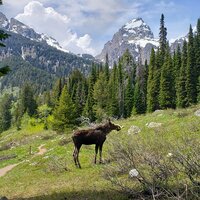
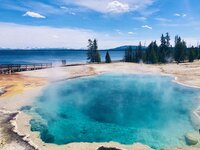
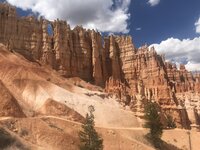
Comments
Comments Off on 4 Days in Kyrgyzstan: Touring Through Canyons Around Issyk-Kul Lake, Mountains, Meadows, Yurts & Eagle Hunting